

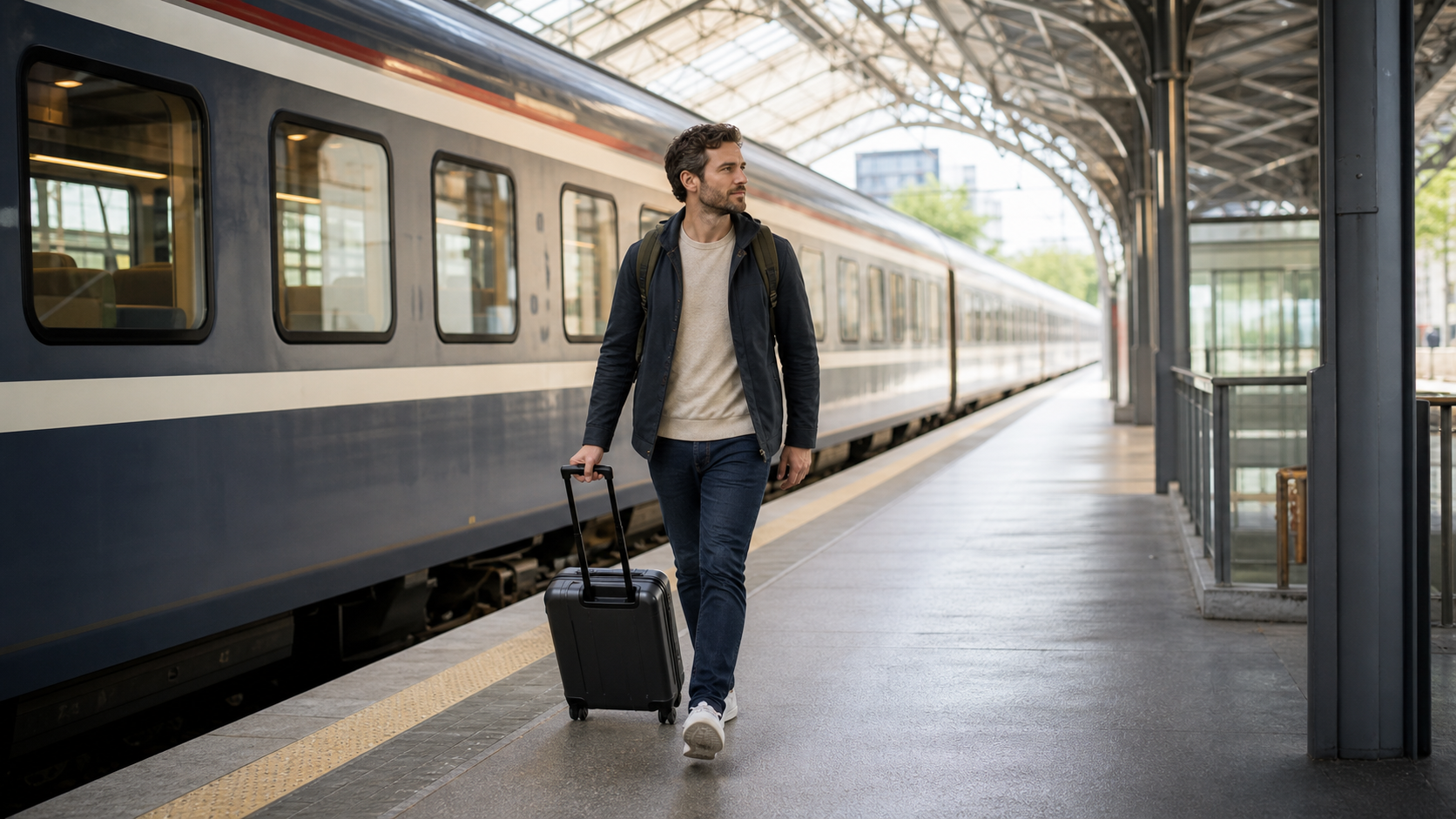
The best luggage for train travel is the smallest setup you can comfortably lift, carry, and stow without help. For most travelers, that means one carry-on-sized roller or compact travel backpack plus one small personal item. A larger suitcase may hold more, but every stairway, platform change, narrow aisle, and short connection turns that extra capacity into a handling problem.
Unlike a typical flight, many rail journeys keep you responsible for your bag from station entrance to seat. The right choice is therefore less about maximizing volume and more about reducing the number of difficult moves you must make.
Quick answer: use the one-lift rule
Pack the bag, then confirm you can lift it to rack height, carry it up one flight of stairs, roll or carry it for five minutes, and turn it through a narrow doorway without assistance. If any step feels uncertain, reduce the load or choose a smaller bag.
Why train luggage is a handling decision
Airline luggage planning often begins with check-in and cabin dimensions. Rail travel adds a different set of questions: Who lifts the bag? Where will it sit? How quickly can it move when the platform changes? Can you keep one hand free for a railing, ticket, or child?
A compact bag makes it easier to board without blocking the aisle, place luggage in an overhead rack or end-of-car storage area, and retrieve it during a short stop. It also leaves less room for “just in case” packing. That restraint is useful on multi-city trips, where you may handle the same bag several times a day.
Before buying, picture the least convenient part of your itinerary—not the smoothest station. Cobblestones outside a historic terminal, a staircase without an escalator, a crowded commuter connection, or a rack already holding other bags should influence your choice more than the walk across your bedroom.
Check your train operator before choosing a size
There is no universal rail-luggage allowance. Policies can vary by operator, route, train type, and fare.
- Amtrak: Its current carry-on policy allows one personal item up to 25 pounds and 14 × 11 × 7 inches, plus two carry-on items up to 50 pounds and 28 × 22 × 14 inches each. The Pacific Surfliner carry-on depth is listed as 11 inches. Amtrak also says passengers must be able to lift carry-ons safely onto the luggage shelf and store bags in an overhead rack, under a seat, or in a luggage tower. Review the official Amtrak carry-on policy for your trip.
- Eurostar: Eurostar currently says luggage has no general weight limit, but travelers must transport and stow it safely. It lists a maximum length of 85 cm on routes to and from London and 75 cm on other routes; Standard currently includes two pieces plus hand luggage. Confirm the details on the official Eurostar luggage page.
- Selected Shinkansen services: JR Central says bags totaling 161–250 cm across length, width, and height require a reserved oversized-baggage area on specified Tokaido, Sanyo, Kyushu, and Nishi Kyushu Shinkansen services. Its official oversized-baggage guidance explains the reservation process.
These rules were checked on August 15, 2026. Always confirm current requirements with your rail operator for the exact route, train, and fare before departure. If your trip also includes a flight, confirm the airline and relevant authority rules as well.
Train luggage comparison: choose by the hardest transfer
| Bag type | Best for | Main tradeoff |
|---|---|---|
| Compact 4-wheel spinner | Direct routes, smooth concourses, travelers who prefer to roll the bag beside them | Small wheels need deliberate handling at gaps, curbs, and uneven station approaches |
| Compact 2-wheel roller | Mixed pavement, longer station approaches, and travelers who pull behind | Creates a longer footprint behind you and still must be carried on stairs |
| Travel backpack | Frequent transfers, stairs, short trips, and hands-free movement | Comfort depends on fit and packed weight; remove it in crowded cars |
| Soft duffel | Flexible rack space, simple car-to-train trips, and irregular contents | Easy to overfill and tiring to carry when the load is not balanced |
Four wheels for smooth, direct journeys
A compact spinner can be comfortable in modern stations because it rolls beside you and turns in a small space. It suits a direct intercity trip with elevators, wide platforms, and a predictable place to stow the bag. Keep a hand on it when stopped, especially near sloped platforms or moving trains.
Two wheels for mixed surfaces
A two-wheel carry-on is often the more controlled choice when the route between hotel and platform includes cracked pavement, curbs, or textured surfaces. The recessed wheel layout can preserve more of the bag’s footprint, but pulling it behind you takes extra room in a crowd. Compare compact rollers within Voyage’s carry-on luggage collection.
A backpack when stairs dominate
A properly fitted travel backpack keeps both hands available and removes wheels from the equation. It is especially practical for one- or two-night trips and fast transfers. The downside is physical: a load that feels fine for ten minutes can become uncomfortable after repeated station walks. Start with the bag’s actual packed weight, not its empty capacity, when browsing travel backpacks.
A duffel only when you can resist overpacking
Soft sides can fit irregular rack spaces, but the flexible shape invites extra items. A duffel is best when the walk is short or the load is light. If you cannot carry it comfortably on one shoulder without leaning, it is too heavy for a transfer-heavy itinerary. Voyage’s duffel bag collection includes traditional and travel-focused formats.
Three current Voyage options, matched to rail use cases
These are examples, not a universal ranking. Prices and availability below were checked on August 15, 2026.
For mixed surfaces: Eagle Creek Expanse 2 Wheeled International Carry-On
The Eagle Creek Expanse 2 Wheeled International Carry-On measures 21.5 × 13.75 × 10 inches and weighs 5.24 pounds. It uses two reinforced wheels, recycled polyester ripstop fabric, internal compression, an expandable compartment, and lockable zippers. At review time, Pilot Blue, Midnight Black, and Gold were in stock at $268.99. It is a strong fit for travelers expecting outdoor station approaches or mixed pavement; it is less appealing if you strongly prefer rolling a bag upright beside you.

For smooth stations and direct routes: Travelpro Crew Classic Compact Carry-On Spinner
The Travelpro Crew Classic Compact Carry-On Spinner measures 22 × 14 × 9 inches and weighs 6.8 pounds. Its eight-wheel system is designed to self-align, while a removable compression organizer and tapered expansion help manage the interior. Titanium Grey, Black, and Patriot Blue were in stock at $255 when checked. This is the more natural match for smooth concourses and direct journeys; travelers facing repeated stairs should decide whether the added wheel hardware and packed load remain easy to lift.

For short trips and frequent stairs: Travelpro Platinum Elite Slim Backpack
The Travelpro Platinum Elite Slim Backpack measures 16 × 12 × 6 inches and weighs 2.2 pounds. It includes padded sleeves sized for laptops up to 16 inches and tablets up to 12.9 inches, plus a rear stacking strap. Black, Vintage Grey, and True Navy were in stock at $215 when checked. It works well for an overnight business trip or as the small bag paired with a roller, but its slim format is not intended to replace a larger suitcase for travelers carrying several changes of clothing.

Match the bag to your itinerary
- Direct intercity journey: A compact spinner is usually easy to manage when the stations are accessible and the bag has one predictable storage move.
- Multi-stop trip: Favor a light two-wheel roller or travel backpack. Every connection multiplies the value of a smaller load.
- Sleeper or long-distance train: Keep medication, documents, valuables, a layer, and overnight essentials in the small bag that stays at your seat or berth. Place only replaceable, less frequently needed items in the main suitcase.
- Rail plus flight: Measure the bag including wheels and handles, then plan to the strictest rule in the itinerary. A bag accepted on a train is not automatically compliant with an airline.
Try the five-minute rail-readiness test
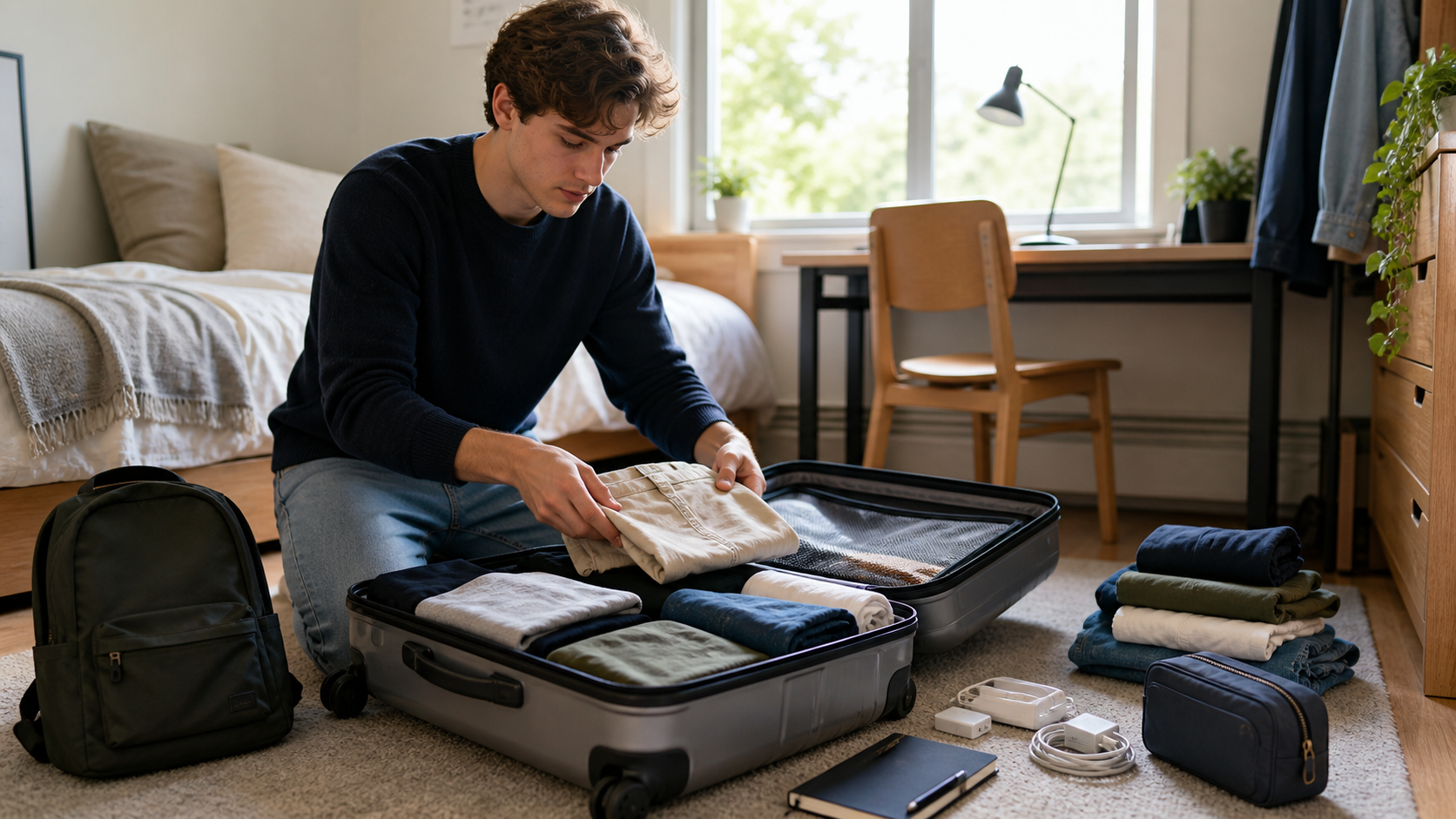
- Pack the exact shoes, clothing, and electronics you plan to take.
- Lift the bag from the floor to shoulder height without twisting or holding your breath.
- Carry it up and down one flight of stairs while keeping one hand available for the railing.
- Walk with it for five minutes, including two tight turns and one doorway.
- Open the pocket holding your ticket, identification, phone, or charger without unpacking the main compartment.
If the test exposes a problem, remove items before changing bags. Small packing cubes can separate clothing by stop, but organizers do not reduce weight. For broader buying criteria, see Voyage’s guide to what to look for in luggage.
Frequently asked questions
Is hardside or softside luggage better for train travel?
Neither material wins every route. A hardside case keeps a consistent shape and protects against compression, while a softside bag may fit more easily into an irregular rack and often adds exterior access. The decisive factors are packed weight, dimensions, handle control, and whether you can lift it safely.
Are two wheels or four wheels better on trains?
Choose four wheels for smooth stations, direct routes, and upright rolling. Choose two wheels when the approach includes rough pavement or curbs. Both must still be light enough to carry on stairs and place in the available storage.
Can I bring a large suitcase on a train?
Sometimes, but permission is only half the question. You may need to reserve storage, use a designated area, or meet route-specific limits. Large bags also create a harder lift and slower exit. Check your operator’s current policy and choose a size you can manage independently.
What should stay in my personal item?
Keep identification, tickets, wallet, medication, phone, charging gear, essential documents, and other valuables with you. Add a light layer and the few items you would need if access to the main bag were delayed. Follow the operator’s security and prohibited-item rules.
The best train bag is the one you can move confidently
The best luggage for train travel is not necessarily the bag with the most capacity. It is the setup that remains controlled when the platform changes, the elevator is unavailable, or the rack is above your head. Start with one manageable main bag, add only a compact personal item, and test both at the real packed weight.
When you are ready to compare sizes and wheel formats, browse Voyage’s current carry-on luggage and choose around your hardest transfer—not your longest packing list.
Voyage Luggage sells some of the products mentioned in this guide. Availability, specifications, and pricing may change.
Share:
Cruise Carry-On Packing List for Embarkation Day
Study Abroad Packing List: What Goes in Each Bag