

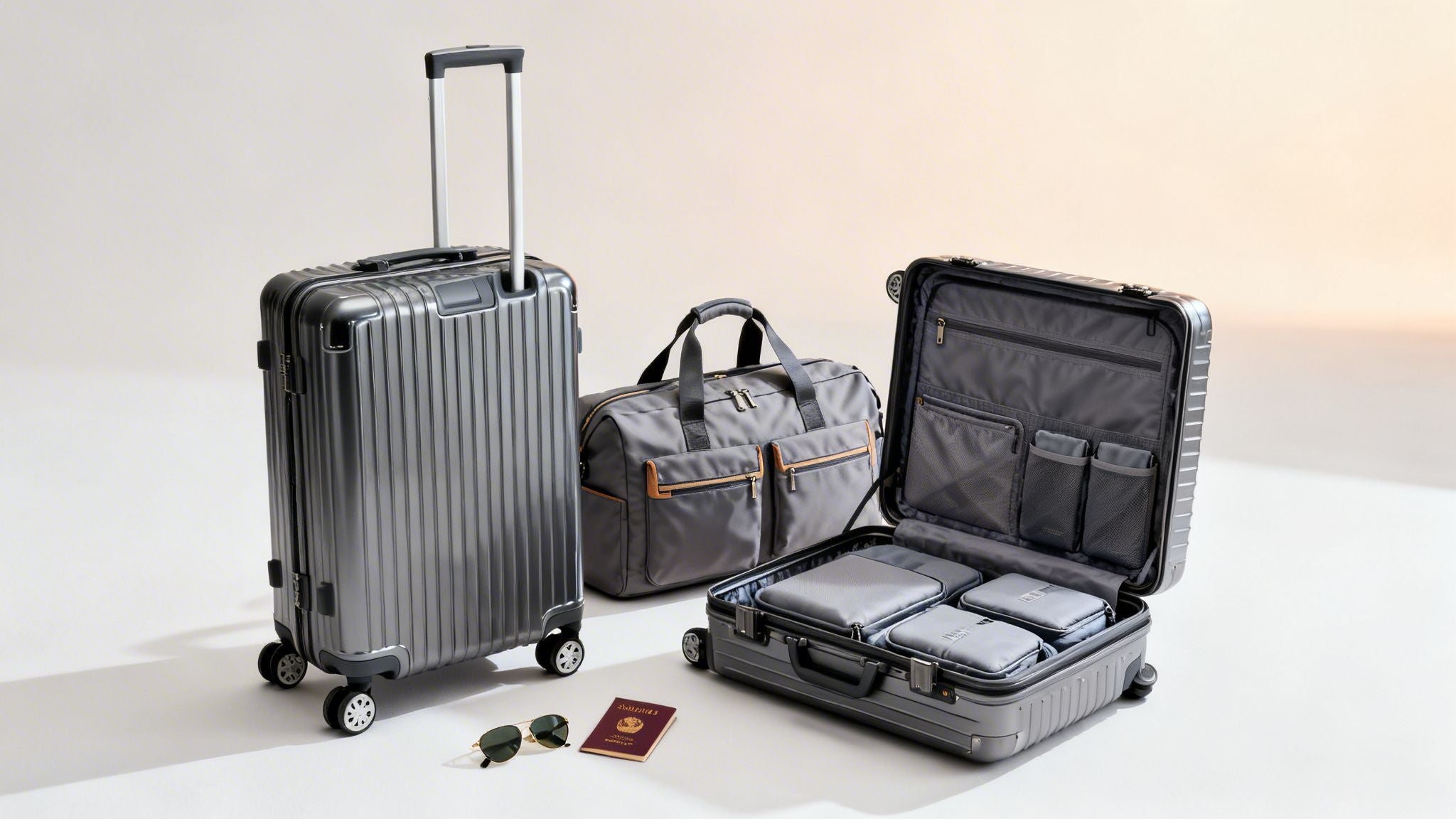
The right luggage isn't just a box for your stuff—it's a travel partner. It all comes down to matching the size to your trip, picking a material like tough polycarbonate or ballistic nylon that can take a beating, and making sure it has solid wheels and handles that won't give out on you.
Your Journey Starts with Smarter Luggage Choices
We’ve all been there: standing in a store, staring at a wall of suitcases, feeling completely overwhelmed. It's easy to get lost in the sea of different sizes, materials, and brands.
This guide is designed to cut through that noise. Instead of just listing features, we'll walk you through a practical way to figure out what you actually need based on how you travel. Let’s move past the generic advice and find a bag that will truly work for you.
Define Your Travel Profile
Before you even look at a single suitcase, the first step is to think about yourself. Seriously. Your personal travel style is the single most important factor. Are you a road warrior who practically lives out of a carry-on for business trips? Or are you getting the whole family packed up for a two-week international vacation?
Thinking through these points will narrow down your options in a hurry:
- Trip Duration: Are you mostly a weekend warrior, or are you planning multi-week adventures?
- Travel Type: Do you fly, drive, or hop on trains? How you get there really impacts what kind of size and weight you can manage.
- Packing Style: Are you a proud minimalist who can get by with just the essentials, or are you the type who needs extra room for souvenirs on the way back?
Someone flying for a two-day business meeting needs something completely different from a family heading to a resort. The business traveler probably wants a sleek, professional-looking carry-on with a padded laptop sleeve. The family, on the other hand, might be better off with a large, expandable checked bag that can hold everyone's gear.
Key Takeaway: The "perfect" suitcase isn't about the bag itself. It's about how perfectly that bag fits your life. Figure out your needs first, and the right choice will become much clearer.
By the time you're done with this guide, you won't just know the difference between hardside and softside luggage. You'll have the confidence to pick a travel companion that will be with you for years to come. We’ll give you the inside scoop on top brands, smart shopping tips from retailers like Voyage Luggage, and a breakdown of the features that actually make a difference when you're on the move.
Get the Size and Rules Right—Before You Buy
Before you fall in love with a suitcase's color or features, let’s talk about the single most important factor: its size. This isn't just about how much you can pack; it's about navigating the often-tricky world of airline rules and avoiding surprise fees. Get this right, and you’ll glide through the airport. Get it wrong, and you could be facing a hefty bill at the check-in counter.
It’s no surprise the global luggage market is projected to grow by USD 16.64 billion by 2029—travelers are getting smarter about buying bags that fit the rules. For anyone who travels for work, a carry-on that meets the universal 22 x 14 x 9 inches IATA standard is an absolute game-changer. It means you can skip the checked-bag fees and the dreaded wait at the baggage carousel.
First, Match the Bag to Your Trip
Let's break it down. Thinking about luggage in these three main categories will immediately help you figure out what you actually need.
-
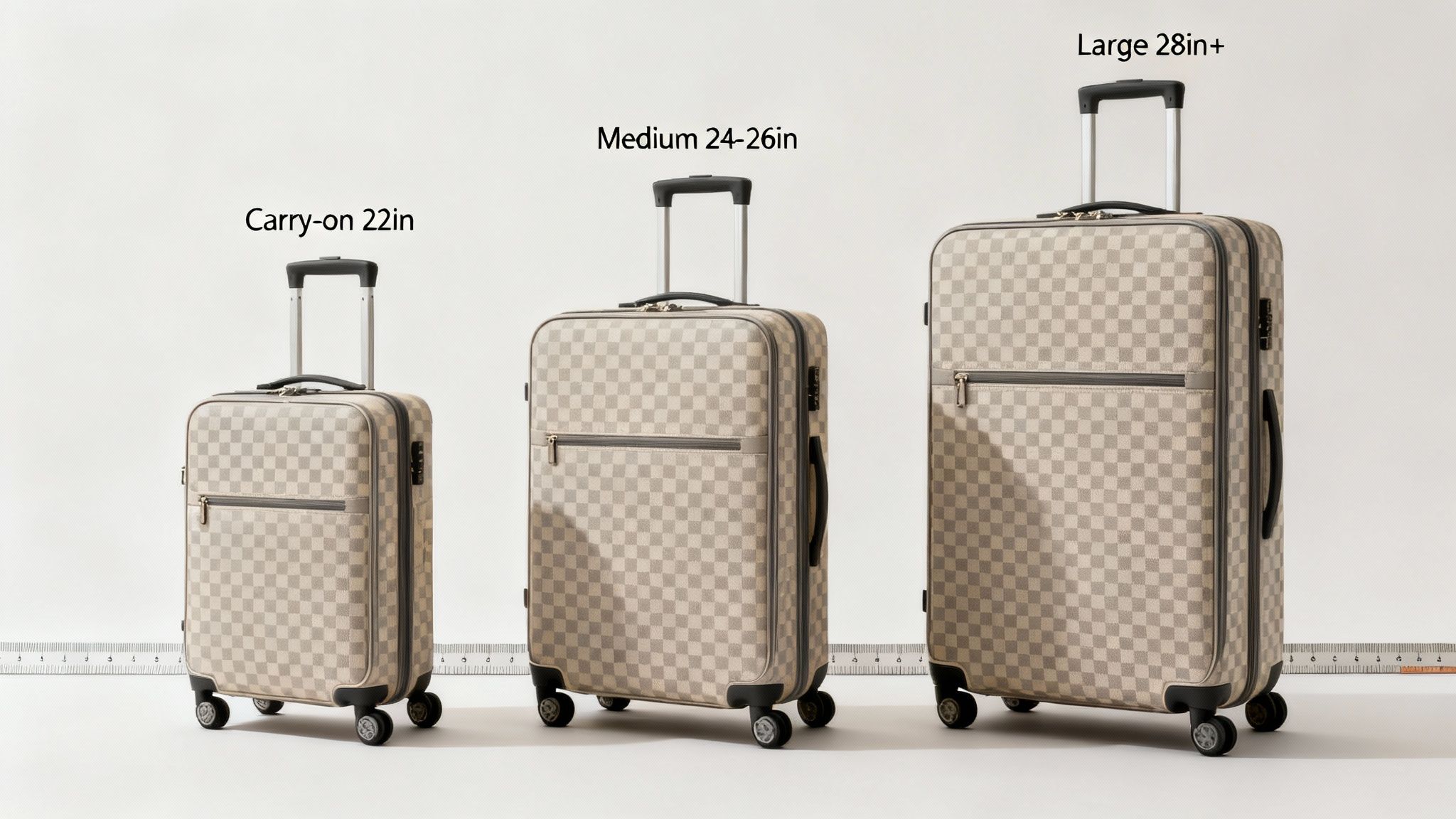
Carry-On (up to 22 inches): This is your best friend for short jaunts—think weekend getaways or 2-3 day business trips. If you love packing light and hitting the ground running, this is the one for you.
-
Medium Checked (24-26 inches): Planning a week-long vacation? This is your sweet spot. It offers a great balance, giving you enough room for a variety of outfits without feeling like you're dragging a giant trunk behind you.
-
Large Checked (28+ inches): For the serious traveler. This is the choice for trips longer than a week, family holidays where you're packing for multiple people, or if you need to bring bulky gear like ski boots or diving fins.
And don't forget, if you’re bringing a pet, their carrier counts too. Always double-check the latest airline pet travel carrier regulations because they can be just as strict as the rules for your own bag.
A Quick Tip from Experience: When you measure a suitcase, always include the wheels and handles. Airlines measure the total external dimensions, and I’ve seen people get turned away at the gate because a handle or wheel pushed their bag just half an inch over the limit.
To make it even clearer, here’s a quick-reference table to help you visualize which size fits your travel style.
Luggage Size and Recommended Trip Length
This handy chart matches standard luggage dimensions to trip durations and common traveler profiles, taking the guesswork out of your decision.
| Luggage Size (Inches) | Best For (Trip Length) | Traveler Type Example |
|---|---|---|
| Up to 22 | 1-3 Days | The Weekend Warrior, The Business Professional |
| 24-26 | 4-7 Days | The Vacationer, The Light Over-Packer |
| 28+ | 7+ Days | The Globetrotter, The Family on Holiday |
Ultimately, choosing a size is about anticipating your needs before you're standing in front of an open, empty suitcase the night before a flight.
The Carry-On "Magic Number"
While every airline has its own nuances, the magic number for carry-on luggage is 22 inches tall, 14 inches wide, and 9 inches deep. If you find a bag that fits these dimensions, you can fly with almost any major airline without worry.
Making this smart choice from the get-go is the foundation of a stress-free travel day. If you're a frequent flyer who prefers to keep your bag with you, getting this one decision right is key. For a deeper dive, our guide on how to pick the perfect carry-on has all the details you’ll need.
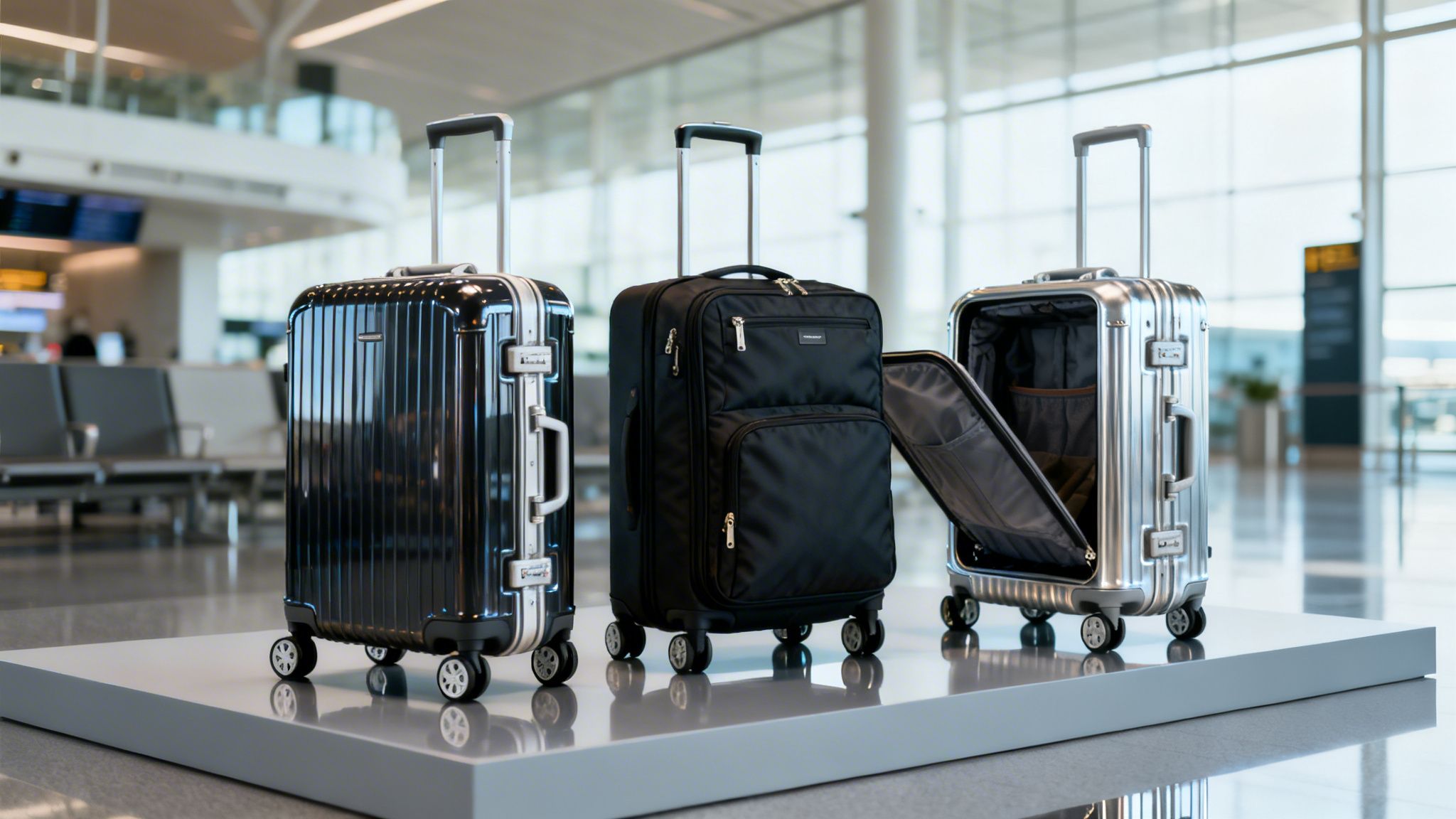
Hardside vs. Softside: Which Suitcase Is Right for You?
The hardside vs. softside debate is probably the biggest decision you'll make when buying a new suitcase. This isn't just about looks—it's about how the bag will hold up, how much it weighs, and how it fits your packing style. Let's dig into the real-world differences to figure out which one makes sense for your travels.
Think about what you pack. Are you a photographer with delicate lenses? A wine lover bringing back a few precious bottles? If so, the rigid, armor-like protection of a hardside suitcase is a no-brainer. It’s a personal vault for your valuables.
The Case for Hardside Luggage
Forget those old, clunky plastic suitcases that would crack if you looked at them wrong. Modern hardside luggage is a completely different beast, engineered from high-tech materials that masterfully balance strength with a surprisingly low weight.
- Polycarbonate: This is the top dog in the hardside world. It's built to flex under pressure—literally. When it gets hit, it bends to absorb the impact and then pops right back into shape. That flexibility is what makes it so crack-resistant.
- ABS (Acrylonitrile Butadiene Styrene): A bit lighter on the scale and on your wallet, ABS is a solid choice. It's not quite as indestructible as pure polycarbonate, but it offers fantastic rigidity and protection for the everyday traveler.
- Aluminum: The undisputed king of cool and protection. An aluminum case is tough, incredibly secure, and has a timeless, premium look. The trade-off? It's the heaviest and priciest of the bunch, and it will collect dings and dents over time—which many travelers see as a badge of honor.
Beyond just being tough, hardside bags offer better water resistance, which is a lifesaver if your bag gets left on a rainy tarmac. They're also a breeze to clean; just wipe them down and you're good to go.
Real-World Scenario: Picture a tech consultant heading to a big conference with a laptop and fragile product prototypes. They're grabbing a polycarbonate hardside carry-on. Why? Because they know that unyielding shell will protect their gear from getting crushed in a stuffed overhead bin.
The Enduring Appeal of Softside Luggage
Even with all the hardside innovations, softside luggage is still a massive favorite for a reason. It all comes down to one word: flexibility.
Softside bags are typically crafted from incredibly tough fabrics like ballistic nylon or Cordura—materials designed to resist scrapes, scuffs, and tears for years. But their killer feature has always been the exterior pockets. Having a place to quickly stash a book, your passport, or a light jacket without opening the entire suitcase is a game-changer.
And for anyone who's ever tried to cram one last souvenir into their bag, the forgiving nature of fabric is a godsend. Many softside models come with an expansion zipper that gives you an extra two or three inches of precious packing space. This adaptability is exactly why it's such a trusted choice for seasoned travelers. In fact, market data shows that softside luggage still holds about 62% of the global market share as of 2024. If you're a data nerd, you can dive deeper into luggage market trends at Persistence Market Research.
So, what's the final verdict? It really boils down to what you value most. Do you need maximum protection and a sleek, modern aesthetic? Or is it all about packing flexibility and having easy-access pockets? Once you answer that, you’ll know exactly which bag is your perfect travel partner.
The Features That Actually Matter
Once you’ve settled on the shell material, it's time to get into the nitty-gritty. These are the components you’ll use every single trip, and they’re often what separates a genuinely great suitcase from a frustrating one. Think of it this way: the shell is the body of the car, but the wheels, handle, and interior are what make it a pleasure to drive.
Wheels: The Foundation of a Smooth Journey
Your suitcase's wheels are its direct connection to the ground, and a shoddy set can turn a calm walk to your gate into an absolute battle. You’ll generally encounter two types out in the wild.
- Two-Wheel (Inline) Suitcases: These are the classic "pull-behind-you" bags. Their wheels are often larger and recessed into the case, which makes them incredibly durable. If you know you'll be dragging your bag over cobblestone streets, gravel paths, or cracked city sidewalks, these are your best bet.
- Four-Wheel (Spinner) Suitcases: Ah, the spinner. These glide effortlessly beside you on four wheels that rotate a full 360 degrees. Their real magic is in crowded spaces—think tight airplane aisles or winding security lines—where maneuverability is key. They take all the strain off your arm and shoulder.
This decision tree can help you visualize which type of luggage, hard-shell or soft-shell, might be a better fit for the way you travel.
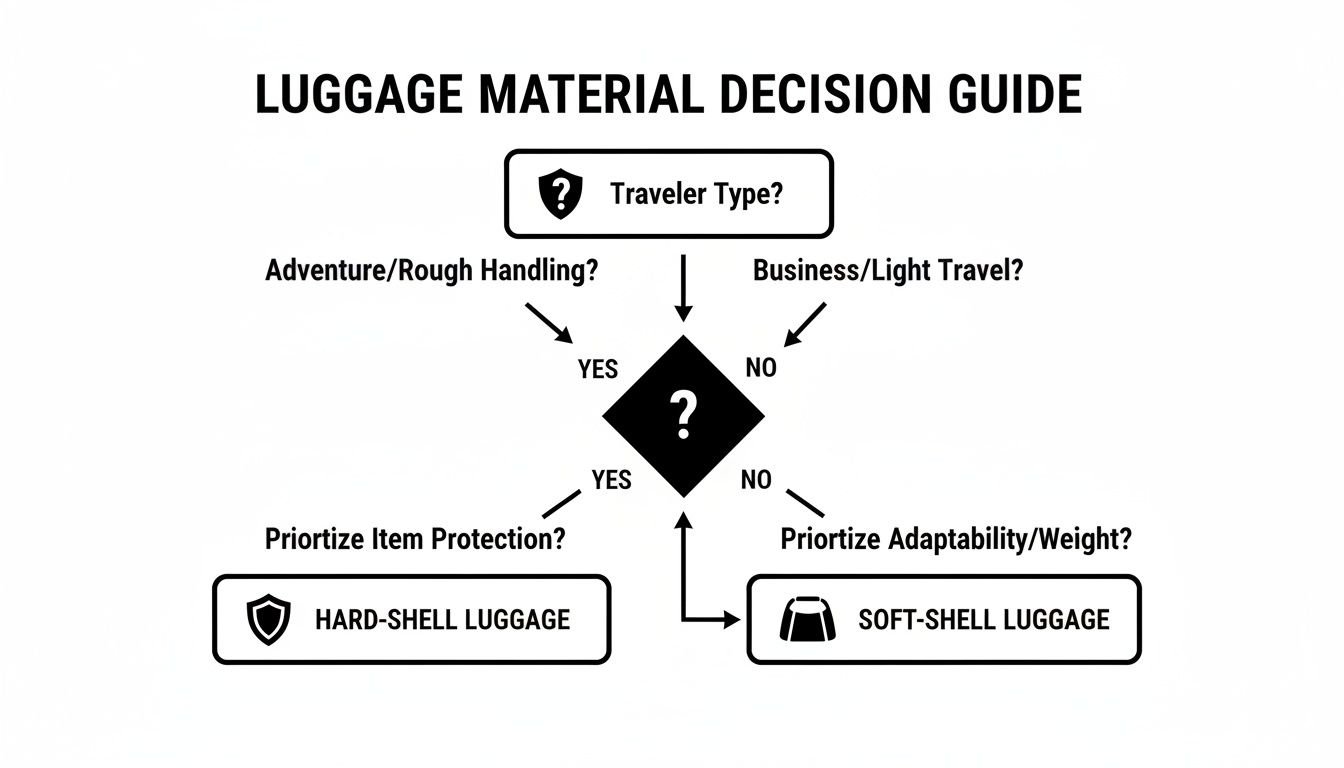
It’s a quick gut-check to see if the fortress-like protection of a hardside case or the flexible convenience of a softside one aligns with your packing style.
Handles, Organization, and Security
Let's talk about the telescoping handle. This is one of the most common failure points on cheap luggage. A flimsy, wobbly handle is a dead giveaway of poor quality. You want a multi-stage handle crafted from high-grade aluminum that locks firmly into place at different heights without rattling. It should feel solid and give you confident control.
What’s on the inside counts just as much. Thoughtful organization isn't just a bonus; it can completely change how you pack and live out of your suitcase.
- Compression Systems: A must-have for over-packers. These use straps or entire panels to cinch your clothes down, freeing up a surprising amount of extra room.
- Divider Panels: Zippered dividers are brilliant for creating distinct compartments. Use one side for shoes and toiletries and the other for clothes, or keep clean and dirty laundry separate on your way home.
- Suiter Compartments: For business travelers, this is a non-negotiable. It’s a dedicated section designed to keep a suit, dress, or blazer as wrinkle-free as possible.
Finally, you can’t overlook security. A TSA-approved lock is an absolute essential for any bag you plan on checking. These locks allow TSA agents to inspect your bag with a master key if needed, so they don't have to break your lock (or your zipper) to do it. An integrated TSA lock built right into the suitcase offers the most seamless peace of mind.
Want to dive deeper? We cover all the little details in our guide on the best qualities to look for in a suitcase.
Investing in these features isn't just about convenience. Consumer reports have shown that budget luggage fails in 40% of rough-handling tests. Quality components are a necessity, not a luxury. With the global luggage market projected to hit $101 billion by 2035, it’s clear that durable, well-designed features are what make a suitcase a truly worthwhile investment.
Factor in the Brand and Warranty
When you’re hunting for the perfect suitcase, it’s so easy to get caught up in the immediate details—the smooth roll of the wheels, the number of pockets, the color. But here’s something I’ve learned over countless trips: the name on the front of that bag and the warranty behind it are just as important as any feature.
A good suitcase is an investment. The right brand can be the difference between a bag that survives a single rough trip and a trusted companion that joins you on adventures for years to come.
Think about it. Anyone can stitch fabric around a frame, but the brands that have been around for a while put their products through absolute hell. They have machines that simulate years of abuse—tumbling, dropping, and dragging bags to pinpoint every potential weak spot. This is why names like TUMI, Briggs & Riley, and Samsonite have earned their reputations; they obsess over quality control and use materials you can genuinely feel are a cut above the rest.
Think of a Warranty as Your Travel Insurance
A warranty is more than just fine print; it tells you exactly how much a company believes in its own product. See a flimsy one-year warranty? That’s a pretty good sign the manufacturer doesn't expect the bag to hold up much longer than that.
A lifetime guarantee, on the other hand, is a bold promise. It’s the company saying, "We built this to last. If something goes wrong, we've got your back."
That kind of peace of mind is priceless. When an airline handler treats your bag like a bowling ball and a wheel snaps off, a great warranty means you get a repair or a replacement, not a hefty repair bill. It turns a potential travel nightmare into a minor hiccup. This is where a brand like Briggs & Riley really stands out with its famous "Simple as That" lifetime guarantee, which covers functional damage, no questions asked.
Key Takeaway: A lifetime warranty isn't just a marketing gimmick; it's a smart financial move. Spending more upfront for a bag with an ironclad guarantee can easily save you hundreds of dollars by eliminating the need to buy a new suitcase every few years.
Balancing Your Budget with Real Value
Let’s be realistic—budget is always a factor. A premium suitcase can feel like a major splurge, but I always suggest reframing it as a "cost-per-trip."
For example, a $100 bag that you have to replace every two years will cost you $500 over a decade of travel. A single $400 suitcase with a lifetime warranty that lasts that entire time? That’s the real bargain.
When you're figuring out how much to spend, here’s a good way to think about it:
- Entry-Level (Under $150): Perfectly fine if you only travel once or twice a year. Just know that zippers, wheels, and handles are likely to wear out sooner.
- Mid-Range ($150-$400): This is the sweet spot for most travelers. You get durable materials and solid warranties from trusted brands like Travelpro and Samsonite.
- Premium ($400+): You’re paying for top-of-the-line materials, incredible engineering, and often, lifetime guarantees from brands like Briggs & Riley.
Looking into a brand's reputation also means checking out their customer support and the ease of their warranty registration process. For a deeper dive into what different brands promise, our guide on which suitcases have the best warranty is a fantastic resource.
Ultimately, by investing in a brand with a proven track record, you’re not just buying a box on wheels. You’re buying reliability for every journey ahead.
Alright, you've done the hard work. You know your travel style inside and out, you’ve debated the merits of hardside versus softside, and you have a mental checklist of every must-have feature. Now comes the fun part: actually buying the thing.
Where you decide to pull the trigger can be just as crucial as which bag you choose. It really boils down to two main paths: the endless aisles of the internet or the hands-on experience of a physical store.
Online vs. In-Store: Where Should You Buy?
Shopping with a dedicated online retailer like Voyage Luggage puts a massive, curated selection at your fingertips. It’s incredibly convenient to sit on your couch, meticulously compare specs across different brands, and dive deep into what other travelers are saying in the reviews. A few clicks, and your top choice is on its way to you.
But I'll be the first to admit there's a certain magic to seeing luggage in person. Nothing beats the tactile experience of actually grabbing a handle, giving the wheels a test spin across the floor, or feeling the texture of the material. It's the only way to get a true sense of the bag's weight and build quality, and you can get some great face-to-face advice from people who know their stuff.
For a big purchase like this, I always recommend a hybrid approach. It gives you the best of both worlds.
- Do your homework online: Use the detailed product pages and reviews to create a shortlist of your top two or three contenders.
- Try them out in person: If you can, head to a store—like one of Voyage Luggage’s Miami locations—to get a feel for your finalists.
- Buy where it makes sense: Make the final call based on the best value, whether that's an online-only discount or a special promotion you find in the store.
How to Score the Best Possible Deal
Getting great value doesn’t mean just grabbing the cheapest bag you can find. It’s about securing the highest quality piece you can for the money you're willing to spend. A little patience here goes a long way.
Keep an eye out for seasonal sales. Big holidays and the end of a season are classic times for retailers to clear out inventory, and that often means significant markdowns on fantastic luggage.
My favorite pro tip? The simplest way to save is often just by signing up for a retailer's email newsletter. Brands like Voyage Luggage regularly send out exclusive discount codes, early alerts for major sales, and even special bundle offers directly to their subscribers. It’s a low-effort way to make sure you never miss a deal.
Common Luggage Questions Answered
Even after you've done all your homework, a few lingering questions can stand between you and the perfect suitcase. It’s completely normal. Getting these last few details ironed out will give you the confidence to finally pull the trigger on a bag you'll love for years to come.
What Should I Expect to Pay for Good Luggage?
Think of a great suitcase as an investment in your travel sanity, not just a one-off purchase. For a solid carry-on from a brand that stands by its products, you should budget somewhere in the $150 to $400 range. For larger checked bags, that number typically bumps up to $200 to $600.
Sure, you'll see premium brands with higher price tags, but they often come with lifetime warranties that make the upfront cost worthwhile. The real trick is finding that sweet spot between your budget and long-term value. A cheap bag you have to replace every other year ends up costing you more than a quality one that can handle a decade of adventures.
Are Four Wheels Really Better Than Two?
This one truly comes down to your personal travel style and the destinations you frequent.
Four-wheel spinners are a dream in smooth environments. The 360-degree maneuverability lets you effortlessly glide the bag right alongside you, taking almost all the strain off your arm and back. If your travel is mostly airport terminals and hotel lobbies, you'll wonder how you ever lived without them.
On the other hand, two-wheel "roller" bags have larger, recessed wheels that are practically built for abuse. They handle rough terrain like cobblestone streets or cracked city sidewalks much more gracefully.
My Two Cents: Picture your last few trips. Were you rolling through modern airports or dragging your bag up the steps of an old European walk-up? If it's mostly the former, a spinner is a no-brainer. If you're an off-the-beaten-path traveler, the ruggedness of two wheels might be a better fit.
What’s the Toughest Luggage Material Out There?
When durability is the name of the game, the material is everything.
-
For hardside luggage: The gold standard is 100% polycarbonate. It's the perfect combination of lightweight and tough, with a unique flex that helps it absorb major impacts without cracking.
-
For softside luggage: Look for ballistic nylon. This stuff was originally developed for military flak jackets, so you know it's serious. Its dense weave is incredibly resistant to the scrapes, tears, and punctures that are an inevitable part of travel.
Ready to invest in a travel partner that lasts? At Voyage Luggage, we’ve hand-picked a collection of the world's best brands, all backed by our own expert advice and commitment to service. Explore our selection and find your perfect match today.
Share:
How to Pack Toiletries for Air Travel: A Simple, Stress-Free Guide
The Ultimate Guide to the Best Luggage Brands for Travel