

Packing for a week isn't about guesswork; it's about a simple, proven strategy. The secret I've learned over countless trips is the 3-to-1 rule: pack three tops for every bottom. This one guideline is the key to creating a versatile, mix-and-match wardrobe that keeps your suitcase light and your outfit options plentiful.
Building Your Smart Packing Foundation
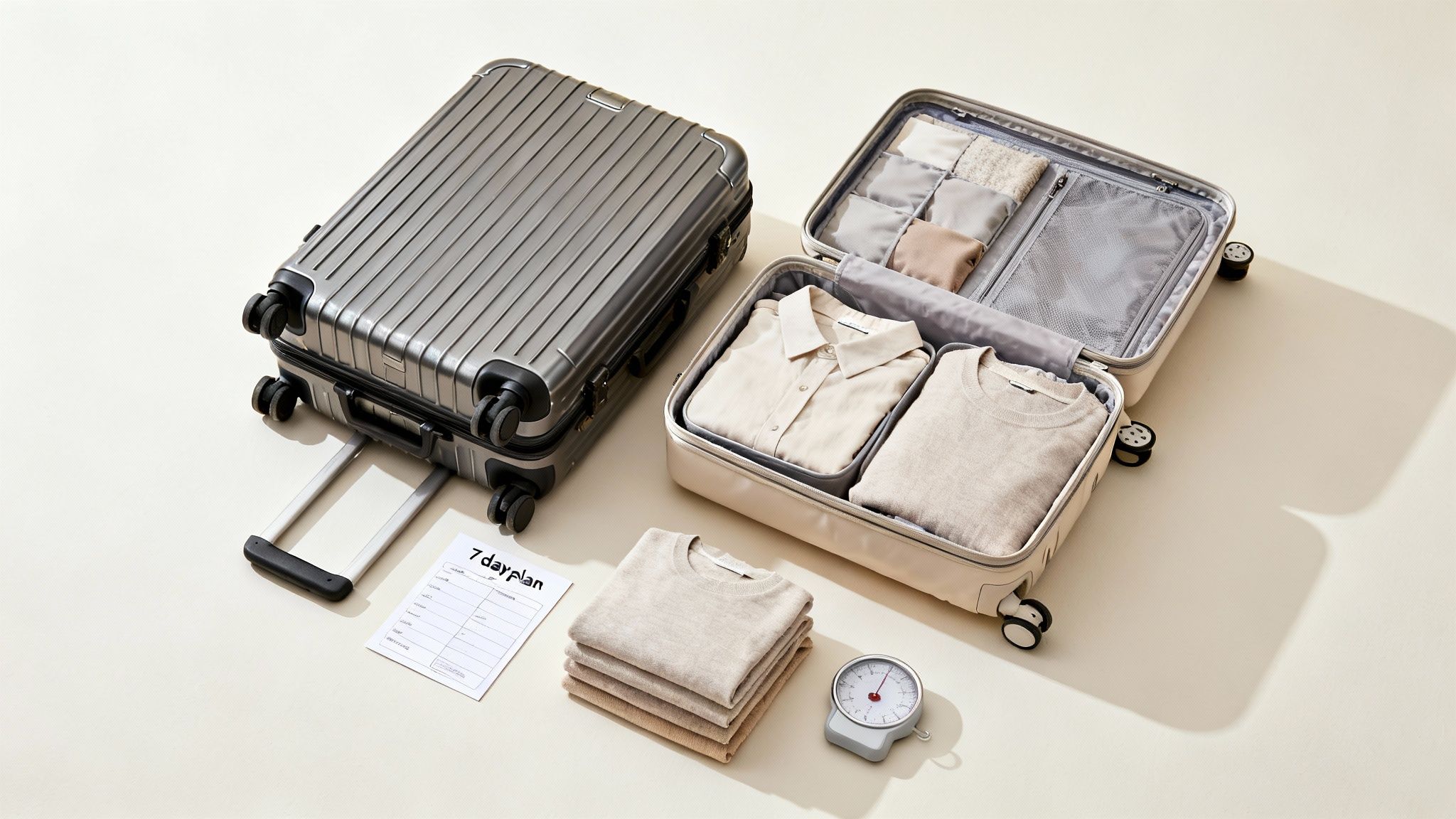
Before you even think about what to pack, you need a solid game plan. This is where most people go wrong. They start with a pile of clothes instead of a clear strategy, which is how you end up with a dozen "just-in-case" items you'll never touch. The real work happens before a single sock goes into the bag—it's about shifting your mindset from packing everything to packing only what's right.
We've all been there. The temptation to throw in one more shirt is strong. In fact, for a 7-day trip, the average traveler packs 8.4 shirts and 6.0 bottoms. It’s no surprise, then, that 40.1% of Americans admit to struggling to close their overstuffed bags, and nearly 20% get hit with unexpected overweight fees at the airport.
Choosing Your Luggage Wisely
Think of your suitcase as the foundation of your entire packing system, not just a box to hold your stuff. The right piece of luggage can make your entire trip smoother, from zipping through the airport to keeping your hotel room tidy.
- Hardside vs. Softside: Hardside bags are fantastic for protecting fragile items and are often surprisingly lightweight. On the other hand, softside luggage gives you that extra flexibility with handy exterior pockets—perfect for stashing a book or a last-minute charging cable.
- Size Matters: For a week, a carry-on is usually all you need. It forces you to be deliberate and pack only the essentials. A medium-sized checked bag offers more room, but it’s a slippery slope to overpacking if you aren't careful.
- Essential Features: Don't overlook the small details. Smooth spinner wheels are non-negotiable for gliding through a crowded terminal. Also, look for a sturdy telescoping handle and high-quality zippers that won’t snag. An expandable compartment can be a real lifesaver for bringing back souvenirs.
The goal is to make your luggage work for you, not against you. A well-chosen bag simplifies every step of the process, from packing at home to navigating a busy airport terminal.
7-Day Trip Quick Packing Blueprint
To give you a clearer picture, here’s a high-level look at how to approach packing for a week. This table breaks down what a well-balanced suitcase looks like, whether you're a minimalist who sticks to a carry-on or someone who prefers the extra room of a checked bag.
| Item Category | Minimalist Approach (Carry-On Only) | Comfort-First Approach (Checked Bag) | Pro Tip |
|---|---|---|---|
| Tops | 4-5 (versatile colors, mix of styles) | 6-8 (more options, including statement pieces) | Pick a neutral color palette to maximize combinations. |
| Bottoms | 2 (e.g., 1 pair of jeans, 1 pair of trousers) | 3-4 (jeans, trousers, skirt, or shorts) | One "dressy" bottom can work for multiple occasions. |
| Outerwear | 1 (a versatile jacket or cardigan) | 2 (e.g., a light jacket and a blazer) | Wear your bulkiest item on the plane. |
| Shoes | 2 pairs (1 walking, 1 versatile/dressy) | 3 pairs (walking, casual, and dressy) | Shoes are heavy; choose them wisely. |
| Underwear/Socks | 4-5 pairs (plan to hand wash) | 7-8 pairs (a fresh pair for each day) | A small travel laundry soap packet is a game changer. |
| Toiletries | Solids & travel sizes (under 100ml) | Full-size favorites (decanted or purchased at destination) | Solid toiletries save space and prevent spills. |
Ultimately, a good plan transforms packing from a dreaded chore into the exciting first step of your adventure.
Thinking mindfully about what you bring not only saves space but also reduces your travel footprint. If you're interested in this approach, learning how to pack for low-impact travel offers some great insights. And for those bigger journeys, especially if you're heading abroad, our packing tips for international travel can provide even more valuable guidance.
Building Your 7-Day Travel Wardrobe
Let's be honest, the biggest packing mistake isn't picking the wrong suitcase. It's cramming it full of random, "just-in-case" clothes that have no relationship with each other. The secret to smart packing is to stop thinking about individual items and start thinking about a cohesive wardrobe.
Building a small, versatile collection of clothes—what some people call a travel capsule wardrobe—is a complete game-changer. It means you can create more outfits with fewer pieces, making packing for an entire week surprisingly simple.
This isn't just about saving space; it's about saving your sanity. No more "what do I wear?" moments on vacation. The stats don't lie: 71.7% of travelers admit to overpacking, and a wild 40% get home with clothes they never touched. A UK survey even found that while men tend to use most of what they pack, women often wear only about 62% of their clothes. You can read more about these travel habits and see why a streamlined plan helps you beat the odds.
Start with a Simple Color Palette
The entire foundation of a mix-and-match travel wardrobe is a simple, intentional color scheme. Ditch the idea of coordinating complex patterns and clashing brights. Instead, anchor your entire selection around a few key colors that play well together.
-
Pick your neutrals: Start with two or three neutral base colors that will form the core of your outfits. Think black, navy, gray, beige, or olive green. These should be your go-to for pants, skirts, and jackets.
-
Add an accent or two: Now, bring in one or two accent colors that pop against your neutrals. This could be anything from a rich terracotta to a bright cobalt blue or even a soft blush pink. Use these for your tops, scarves, and other accessories.
This little system is magic. It guarantees that every single top you pack will work with every single bottom, instantly multiplying your outfit combinations without you even trying.
Master the Rule of Three
When you're deciding on quantities, a great rule of thumb is the "Rule of Three." It's a simple ratio that gives you plenty of variety without letting you get carried away.
The rule is this: plan to pack three tops for every one bottom. So, for a week-long trip, you might bring two pairs of pants and six tops. Or maybe one pair of pants, one skirt, and six tops. The ratio keeps your wardrobe balanced and ensures you'll have a fresh look for every day of your trip.
A truly versatile piece is your most valuable asset when traveling. Think of a wrinkle-resistant shirt that looks just as good on a casual city walk as it does dressed up for dinner. Or a simple black dress that works with sneakers for sightseeing and heels for a night out.
Pick Pieces That Pull Double Duty
Finally, make every item earn its place in your suitcase by choosing clothes that can adapt.
For a business trip, a well-fitting blazer is a perfect example. It's professional for your meetings, but you can throw it on with dark jeans for a relaxed dinner. Heading to the beach? Pack shorts made from a quick-dry fabric that can handle a morning hike and still look good for a casual lunch by the water. If an item can only be worn one way, for one specific occasion, it probably shouldn't make the cut.
Packing Techniques That Actually Create Space
You’ve pulled together the perfect travel wardrobe, but getting it all into your suitcase? That’s a whole different ball game. Learning a few smart packing techniques will not only free up a surprising amount of space but will also keep your clothes organized and looking fresh when you arrive. These are the tried-and-true methods that frequent flyers swear by.
First things first, let's stop just throwing things in the bag. A little strategy goes a long way. Always start by placing your heaviest items—like shoes or your toiletry bag—at the bottom of your suitcase, right by the wheels. This creates a solid center of gravity and stops your bag from constantly tipping over while you’re navigating the airport.
This process gives you a great visual for building out that travel wardrobe from scratch.
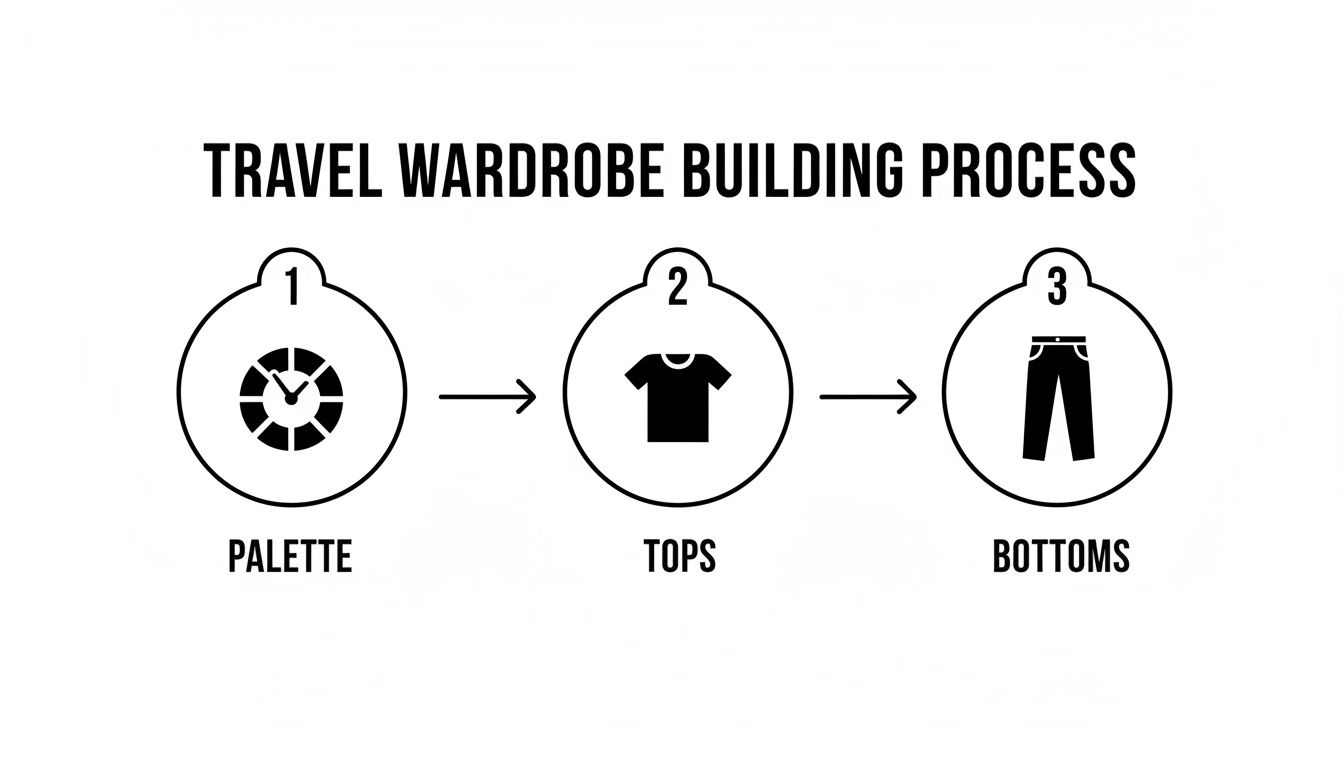
By starting with a color palette, you guarantee every top and bottom you bring can be mixed and matched, giving you way more outfit combinations without overpacking.
The Power of Packing Cubes
If you’re not using packing cubes yet, you're seriously missing out. Think of them as portable drawers for your suitcase. These simple zippered pouches let you group your clothes by category—one for tops, another for bottoms, one for socks and underwear. It’s a game-changer for staying organized on the road.
But they do more than just tidy up. Compression packing cubes are designed to squeeze out all the extra air, which can shrink down bulky items like sweaters and jeans. When you get to your hotel, you can just pull the cubes out and pop them right into the drawers. Unpacking is done in seconds. If you're ready to give them a try, check out some of the best packing cubes for travel to find a set that works for you.
Rolling vs. Folding vs. Bundling Your Clothes
The classic debate: should you roll or fold? For most casual clothes, rolling is the clear winner. Tightly rolling items like t-shirts, knits, and even jeans compresses them and helps prevent those hard, deep-set wrinkles. It also lets you stack them vertically in your suitcase, so you can see everything you packed at a single glance.
But what about items that crease easily, like a blazer or a nice dress shirt? That’s where other methods come in handy.
Packing Method Comparison Rolling vs Folding vs Bundling
Deciding how to pack each piece of clothing can feel like a puzzle. Here’s a quick breakdown to help you choose the right method for the right item.
| Packing Method | Best For | Pros | Cons |
|---|---|---|---|
| Rolling | T-shirts, jeans, casual pants, knits, dresses | Saves a lot of space, minimizes light wrinkling | Not ideal for bulky items or structured garments |
| Folding | Bulky items like sweaters, hoodies, jackets | Quick and easy, good for stacking bulky clothing | Can create sharp creases, uses more space |
| Bundling | Blazers, dress shirts, skirts, delicate items | The ultimate wrinkle-prevention method | Takes more time, can be hard to access one item |
Ultimately, most trips will call for a mix of all three techniques. Use what works best for each specific garment to get the most out of your luggage space.
The bundling method involves carefully wrapping your more delicate clothes around a central "core" item, like a small pouch. Each garment you add protects the one underneath it, creating a soft, wrinkle-proof bundle that fits perfectly into your bag.
Finally, don’t forget to use every last nook and cranny. Your shoes are hollow—don't let that space go to waste! Stuff them with socks, chargers, travel adapters, or other small items. It’s a simple trick that not only saves space but also helps your shoes hold their shape. These little adjustments really do add up, making a massive difference in what you can comfortably fit.
It's funny—we spend so much time planning our clothes, but it's often the little things that create the biggest packing mess. A jumble of leaky bottles, tangled cables, and critical documents can throw even the most organized suitcase into chaos. The secret? Give everything its own dedicated home.
When it comes to toiletries, your main goals are containment and efficiency. If you’re flying carry-on only, you already know the drill: the strict 3-1-1 liquids rule. All liquids need to be in containers of 3.4 ounces (100 milliliters) or less, and they all have to squeeze into a single, clear, quart-sized bag. This is exactly why solid toiletries have become such a game-changer.
Taming Your Toiletries and Tech
Making the switch to solid shampoo, conditioner, and soap bars is one of my favorite packing hacks. It completely bypasses the liquids rule and, even better, eliminates any chance of a shampoo explosion all over your clothes. A quality dopp kit or toiletry bag is essential for keeping everything else contained. For more ideas, you can check out some of our favorite must-have toiletry products to pack for every vacation in our other guide.
Your electronics need the same treatment. I swear by using a small "tech pouch" to wrangle every charger, power bank, adapter, and cable. It's a simple habit that means you can find the right cord in seconds. It also drastically reduces the odds of leaving that crucial phone charger still plugged into the hotel wall. We've all been there.
It’s a surprisingly common mistake. Travelers forget an average of two essential items per trip, with chargers (19.1%) and toothbrushes (22%) topping the list. Creating dedicated pouches for tech and toiletries acts as a mental checklist, making these items harder to forget. Discover more insights about common packing mistakes on Radical Storage.
Managing Documents and Medications
Let’s talk about the non-negotiables: your passport, ID, visas, and any prescription medications. These items should always be in your carry-on bag with you—never, ever in your checked luggage. It’s also smart to have digital copies of your documents saved in a secure cloud service just in case.
Depending on where you're headed, you might need to think about your digital security, too. If you’re traveling to a country with internet restrictions, something like this Essential Guide to a VPN for China Travel can be a lifesaver.
And a final pro tip for medications: always pack them in their original prescription bottles. This helps avoid any potential headaches with security or customs agents. By creating these little systems, you’ll always know exactly where your most important items are.
What to Pack in Your Carry-On Bag
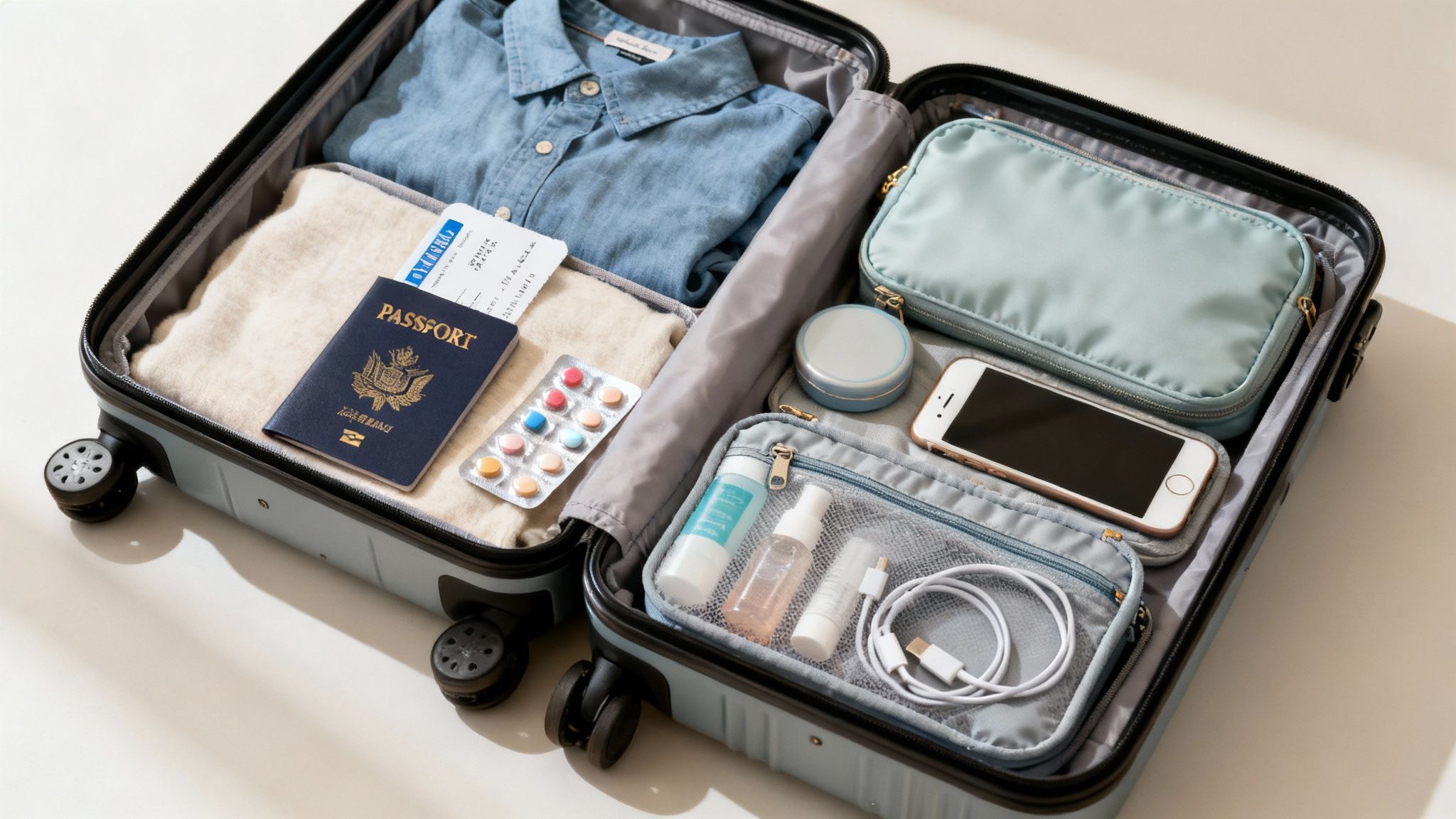
Your carry-on isn't just overflow storage; it's your travel lifeline. This is the bag you know will be with you, no matter what happens to your checked suitcase. Getting it right is probably the single best thing you can do for your peace of mind when you travel.
I learned this the hard way on a trip for a friend's wedding. My checked bag, with my suit and everything else, decided to take an unscheduled vacation to a different city. Fortunately, I’d tossed a full change of clothes—a dress shirt, trousers, fresh socks—into my carry-on. I still had to scramble for a new tie, but that little bit of foresight saved me from missing the entire event.
That experience hammered home what truly needs to stay with you. Your carry-on is your personal insurance policy, stocked with everything you’d need to survive and even thrive for at least 24 hours without your main luggage.
The Non-Negotiable Essentials
Think about what you absolutely cannot afford to lose. These are the items that are either irreplaceable or would cause a major headache if they went missing.
- Travel Documents and Valuables: This one’s critical. Your passport, ID, boarding passes, credit cards, cash, and even your house keys should be in your personal item, not just your overhead carry-on. Keep them close.
- Essential Medications: Never, ever put prescription medications in a checked bag. Always keep enough for the entire trip, plus a few extra days, in your carry-on—preferably in their original bottles.
- Valuable Electronics: Laptops, tablets, cameras, and power banks belong in the cabin with you. Baggage handlers are great, but you don't want your expensive gear getting tossed around or stolen.
Your 24-Hour Survival Kit
Okay, with the critical stuff covered, now you need a small, curated kit to keep you comfortable and functioning if you and your main bag get separated. This is your immediate backup plan.
Your goal is to pack enough in your carry-on to seamlessly continue your trip for a full day if your checked bag gets lost. This simple strategy removes the panic and stress from a common travel mishap.
Here’s what that looks like:
- A Complete Change of Clothes: And I mean a full outfit. Don't just pack a spare t-shirt. Include everything from underwear and socks to a top and bottom that are appropriate for your destination.
- Basic Toiletries: A travel-sized toothbrush, toothpaste, deodorant, and any essential skincare items are must-haves. Remember to follow the 3-1-1 rule for liquids. A few makeup remover wipes can also be a lifesaver after a long flight.
- Comfort and Entertainment: An empty reusable water bottle you can fill up post-security, a few snacks, and a good book or some downloaded podcasts can make any unexpected delay far more bearable.
By treating your carry-on like this, you’re not just packing smarter—you’re creating a buffer against the most common travel frustrations. It’s the secret to starting your trip on the right foot, no matter what the journey throws at you.
Your Final Pre-Travel Checklist
Your bags are packed and everything is perfectly organized. You’re in the home stretch! Before you head out the door, a few final checks can be the difference between a smooth departure and a stressful start to your trip.
First things first, weigh your luggage. Even if you feel like you packed light, it’s always smart to double-check you're under the airline's limit. A small digital luggage scale is a game-changer and can save you from those painfully expensive overweight baggage fees at the check-in counter.
Next, make your bag easy to spot. A sturdy luggage tag with your name and phone number is non-negotiable. I also like to tie a colorful ribbon to the handle—it makes finding my black suitcase on a crowded baggage carousel so much faster and prevents someone else from accidentally walking off with it.
Sample Packing Lists to Get You Started
To take the last bit of guesswork out of the equation, I’ve put together a couple of tried-and-true packing templates. One is geared for a work trip, while the other is all about sun, sand, and relaxation.
Think of these as a foundation, not a set of rigid rules. Always tweak them based on the weather forecast for your destination, your planned activities, and of course, your own personal style.
The 7-Day Business Trip
This list is built around professional, versatile pieces that can take you from a morning meeting straight to a client dinner without a fuss.
- Tops: 2 dress shirts, 2 polo shirts or nice blouses, 1 high-quality t-shirt.
- Bottoms: 1 pair of dress slacks, 1 pair of dark, well-fitting jeans or chinos.
- Outerwear: 1 blazer or sport coat.
- Shoes: 1 pair of comfortable dress shoes, 1 pair of loafers or sleek flats.
- Essentials: Laptop, all necessary chargers, a portable power bank, and a professional notebook.
The 7-Day Beach Vacation
Here, the focus is on lightweight, breathable fabrics that will keep you cool and comfortable from the beach to the bar.
- Tops: 3 t-shirts or tank tops, 2 linen shirts or stylish cover-ups.
- Bottoms: 2 pairs of shorts, 1 pair of lightweight trousers or a maxi skirt.
- Swimwear: 2 swimsuits (so one can dry while you wear the other).
- Outerwear: 1 light sweater or a zip-up hoodie for those cooler ocean-breeze evenings.
- Shoes: 1 pair of sandals or flip-flops, 1 pair of comfortable sneakers for walking.
- Essentials: Sunscreen (SPF 30+), sunglasses, a wide-brimmed hat, and a great book.
Got Questions? We've Got Answers
Even the most seasoned travelers have a few last-minute questions that pop up while staring at an empty suitcase. Let's tackle some of the most common ones I hear about packing for a week-long trip.
How Many Pairs of Shoes Should I Really Pack For a 7-Day Trip?
I live by the rule of three. It's the magic number that covers all your bases without weighing you down.
Wear your bulkiest pair on the plane – think hiking boots or your favorite sneakers. This saves a surprising amount of space and weight.
Then, pack two other pairs:
- A comfortable "all-day" pair: These are your workhorse shoes for walking, sightseeing, or whatever your days involve.
- A versatile "dress-up" pair: Think loafers, stylish flats, or a low heel that can easily transition from a casual dinner to something a bit more formal.
With this simple trio, you’re ready for just about anything.
Carry-On vs. Checked Bag: What's the Right Call For a Week?
This is a classic travel debate, and honestly, it all comes down to your personal style and the trip itself. A carry-on is often more than enough for seven days, especially if you pack smart. The biggest wins? You’ll breeze through the airport on arrival and never have to worry about the airline losing your stuff.
But sometimes, a checked bag is just necessary. If you're heading somewhere cold and need bulky sweaters and jackets, or if you’re an enthusiastic souvenir shopper, that extra space is a lifesaver.
My Non-Negotiable Tip: Even if you check a bag, always pack one complete outfit, your essential toiletries, and any medications in your carry-on. A delayed bag won't ruin your first day if you have the essentials with you.
What's the Secret to Packing Clothes Without Wrinkles?
Nothing's worse than opening your suitcase to a wrinkled mess. My go-to method is a combination of techniques.
Rolling is your best friend for most casual clothes—t-shirts, knits, jeans, and cotton fabrics. It compresses them tightly and really does minimize creases.
For more delicate or structured items like blazers, dress shirts, or silk blouses, I swear by the bundling method. You wrap these items around a central, softer core (like a packing cube full of socks and underwear). It sounds odd, but it works wonders. Packing cubes also play a big role here, as they keep everything snug and prevent clothes from shifting around and getting rumpled.
Ready to put these tips into action with the right gear? Voyage Luggage has a fantastic selection of thoughtfully designed suitcases, backpacks, and accessories that make packing less of a chore. Check out their collections and find your next travel companion at https://voyageluggage.com.


Share:
How to pack garment bag: Travel Wrinkle-Free in Minutes
How to Pack Toiletries for Air Travel: A Simple, Stress-Free Guide