

Before you even think about what to pack, let's talk about the bag itself. Getting this part right is the foundation for a smooth trip. For most travelers, the sweet spot is a 30-45L panel-loading backpack. Think of it as a soft-sided suitcase you can carry on your back—it opens up completely, so you're not digging blindly for a pair of socks.
A good pack with features like a padded laptop sleeve, comfortable straps, and tough, weather-resistant fabric can genuinely make or break your travel experience.
Choosing the Right Backpack for Your Journey
Your backpack isn't just a sack for your stuff; it's your travel command center. The wrong one can lead to an aching back, a disorganized mess, and headaches at the check-in counter. It’s like picking a travel companion—it has to be reliable and a good fit for you and your itinerary. A sleek, professional pack for a business trip to Tokyo is a world away from the rugged gear you'd need for a trek through Patagonia.
The global backpack market is set to reach USD 22.42 billion by 2031, which tells you one thing: people are finally getting serious about their travel gear. For most trips, a bag between 30 and 45 liters is perfect. It’s big enough to hold a week’s worth of clothes (if you pack smart) but still compact enough to pass as a carry-on. That means no checked bag fees and zero chance of the airline losing your luggage.
Panel-Loaders Versus Top-Loaders
This might be the single most important decision you make. How your backpack opens changes everything.
- Panel-Loading Backpacks: These are the way to go for travel. They unzip on three sides, opening flat like a suitcase. You can see everything at once, making packing and unpacking incredibly easy.
- Top-Loading Backpacks: These are designed for hikers. They have a drawstring opening at the top, which is great for stuffing a sleeping bag into, but terrible for finding anything else. You inevitably have to pull everything out just to grab the one thing at the bottom.
For travel, always choose a panel-loader. The convenience of seeing your entire packed wardrobe at a glance, neatly organized in packing cubes, is a massive advantage over the "black hole" effect of a top-loader.
Non-Negotiable Features for Modern Travelers
Beyond the opening style, a few features are absolute must-haves. A dedicated, well-padded laptop sleeve is non-negotiable for protecting your tech. Also, look for bags made from durable, water-resistant fabrics like high-denier nylon or Cordura. You want something that can handle being tossed around and caught in a sudden downpour.
Finally, comfort is king. Don't overlook the importance of well-padded, ergonomic shoulder straps and a supportive back panel. A great backpack distributes weight so well it feels lighter than it actually is. If you're carrying a heavier load, a hip belt is a game-changer. It transfers the weight from your shoulders to your hips, which can save you from a world of pain on long travel days.
If you need some solid recommendations, our guide on the top-rated travel backpacks is a great place to start your search.
Backpack Size Guide for Different Trip Durations
To help you visualize what size you might need, here's a quick cheat sheet. This table breaks down common backpack capacities and the types of trips they're best suited for.
| Trip Duration | Recommended Backpack Size (Liters) | Best For | Example Voyage Luggage Brands |
|---|---|---|---|
| 1-3 Days (Weekend) | 20-30L | Quick getaways, personal item for flights, minimalist urban exploration. | The Nomad, The Urbanite |
| 3-7 Days (Week-long) | 30-45L | The sweet spot for most travel, fits carry-on limits, versatile for all trips. | The Globetrotter, The Explorer |
| 1-4 Weeks | 45-55L | Longer trips, multi-climate travel, or when you need specialized gear. | The Adventurer, The Expedition |
| 1 Month+ | 55L+ | Long-term travel, backpacking adventures where you need to carry more. | The Voyager, The Sojourn |
Remember, this is just a guideline. A savvy minimalist packer could easily make a 35L bag work for a multi-week trip, while someone else might need 45L for a long weekend. It all comes down to your packing style and the gear you need to bring.
Mastering Weight Distribution for a Comfortable Carry
How you load your pack is just as important as what you put in it. Think of it like building a stable structure—if the foundation is wobbly, the whole thing feels off. Proper weight distribution is the secret to making a heavy bag feel manageable and avoiding that dreaded backward pull that kills your back and shoulders.
The goal here is simple: create a solid center of gravity that sits close to your spine. This keeps the pack from swaying or tugging away from your body, which is what causes all that muscle strain. When a pack is unbalanced, your body has to work overtime just to stay upright, leaving you tired and sore long before you even get where you're going.
The Strategic Packing Pyramid
I've found the best way to get a balanced pack is to layer your gear by weight. Picture your backpack in three distinct zones: the bottom, the middle (right up against your back), and the top/front.
- Bottom Zone (Medium Weight): This is where you'll stash things you won't need until you've arrived. Think sleeping gear for a hiking trip or an extra pair of shoes. These items build a stable base for the heavier stuff to sit on.
- Middle Zone (Heaviest Weight): This is the most crucial spot. Your heaviest items go here—your laptop, a dense toiletry bag, or that packing cube stuffed with jeans. You want this weight positioned directly against your spine, right between your shoulder blades.
- Top & Front Zone (Lightest Weight): Your lightest gear and anything you need to grab quickly belongs here. A rain jacket, your snacks, passport, and phone should all be easily accessible at the very top or in the front pockets.
This simple guide breaks down the first few decisions you need to make before you even think about packing, focusing on the right size, type, and features for your trip.
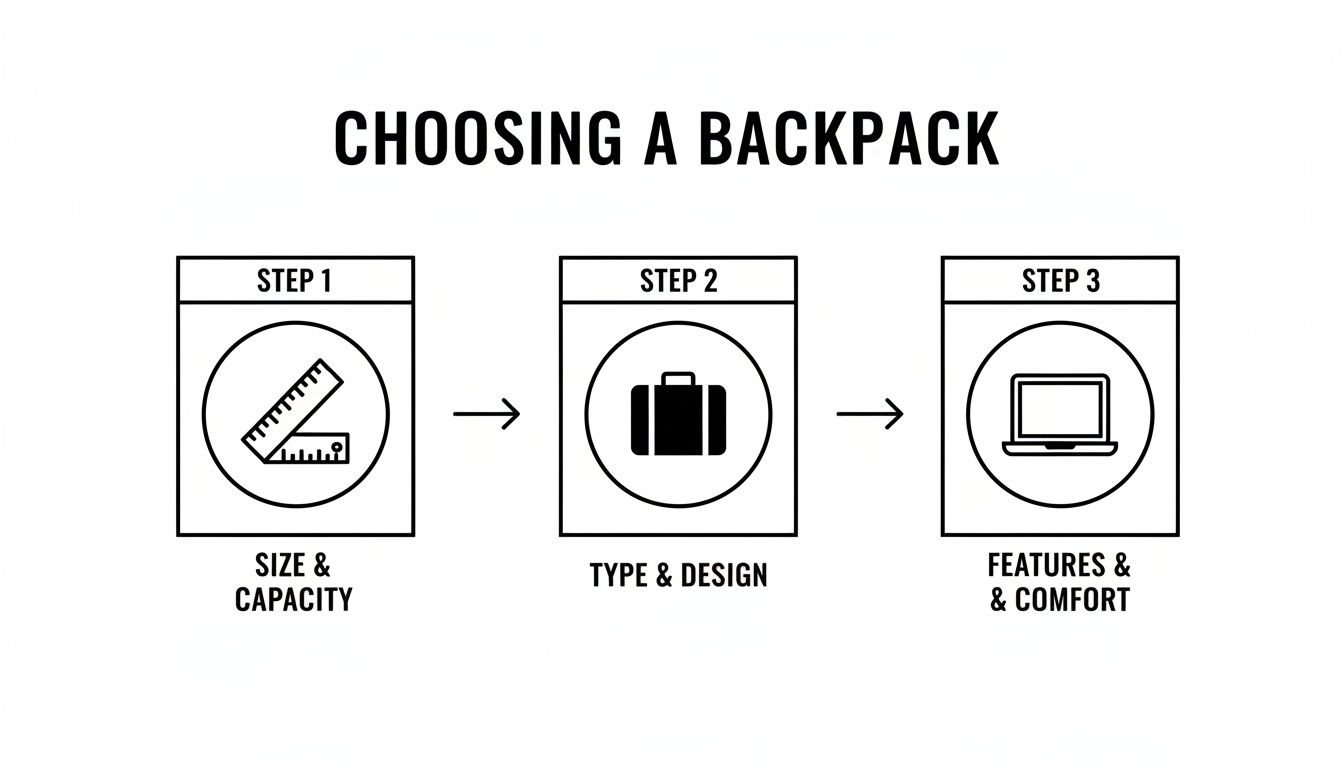
Getting the right pack from the start makes comfortable weight distribution a whole lot easier.
Why This Method Actually Works
Placing the heaviest items against your spine aligns the pack's center of gravity with your body's own. It's a small change that makes a huge difference in your posture and balance. Honestly, this technique can make a 15 kg bag feel dramatically lighter and more stable on your back.
Ignoring this is one of the most common—and painful—mistakes travelers make. In fact, studies show that nearly 80% of travelers complain about back pain from lugging around poorly packed bags. To avoid this, a good rule of thumb is to keep your pack's total weight under 10% of your body weight. This focus on ergonomics is pushing a lot of innovation in travel gear, with the backpack market projected to grow at a 5.5% CAGR to 2030, driven by our demand for features that reduce strain. You can dive deeper into the future of the backpack market on stellarmr.com.
Pro Tip: Once your bag is fully packed, put it on and spend a minute adjusting the straps. The load-lifter straps (the small ones by your shoulders) and the hip belt are your best friends. A properly tightened hip belt should transfer about 80% of the pack’s weight off your shoulders and onto your hips, which are far better at carrying heavy loads.
Proven Space-Saving Techniques
With your backpack’s weight properly distributed, the next game is all about Tetris—fitting everything in without straining the zippers. This is where a few tried-and-true techniques make all the difference. It’s not about just cramming things in; it’s a skill that can magically create more room than you thought you had.
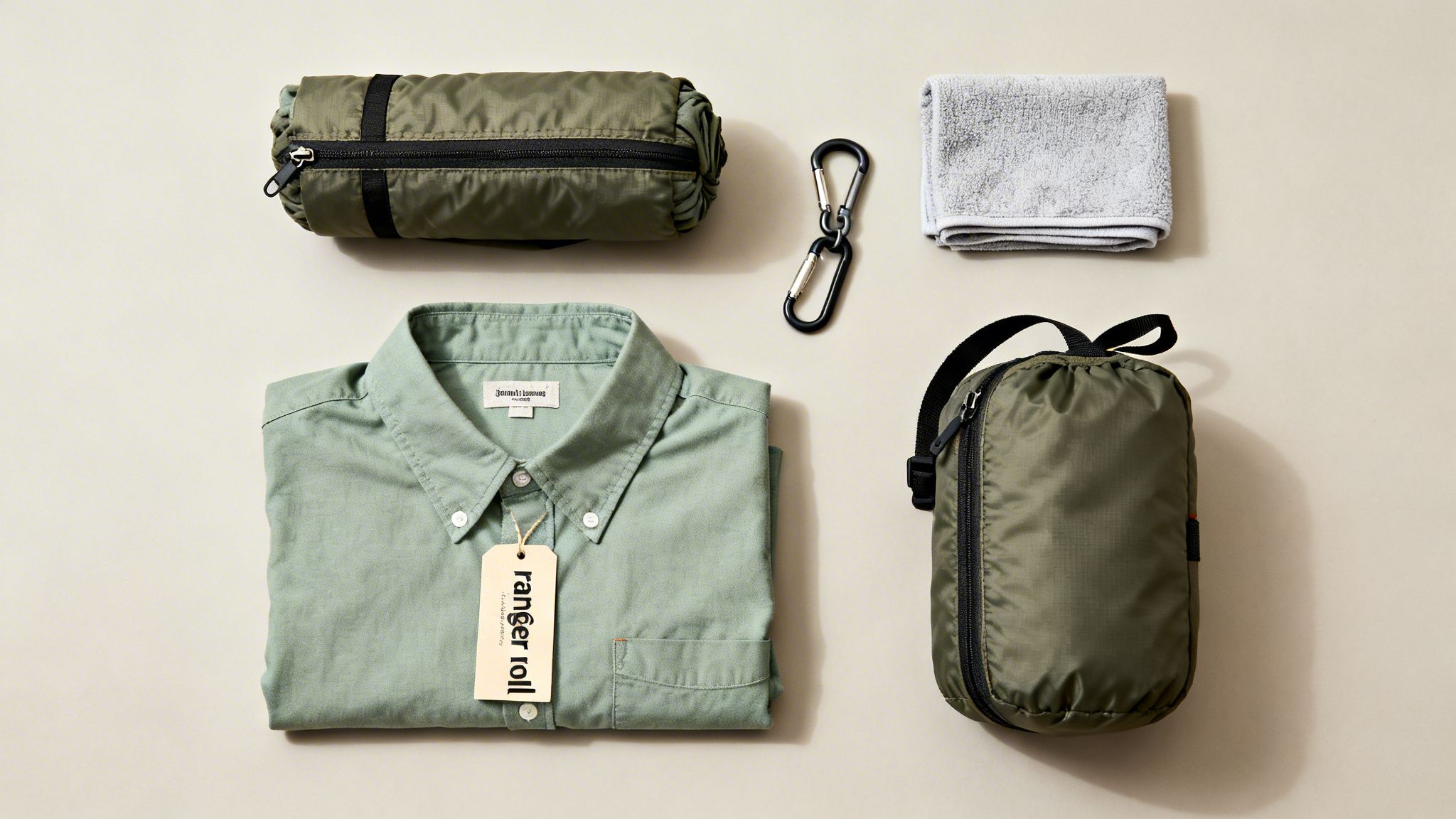
Let’s settle the great debate right now: for backpackers, rolling your clothes is almost always the way to go. Tightly rolling items like t-shirts, jeans, and shorts into little fabric logs does two fantastic things. First, it compresses them down, squeezing out excess air. Second, it dramatically reduces the kind of deep, set-in wrinkles you get from folding.
Beyond the Basic Roll
If you really want to level up your compression game, learn the Ranger Roll. It’s a military technique where you fold the edges of a shirt or pants inward, roll it up super tight, and then tuck the whole bundle into a little cuff you create at the start. What you get is a dense, self-contained cylinder of clothing that won’t unroll and create chaos in your bag.
Of course, not everything benefits from being rolled into a tube. Bulkier or more structured pieces, like a blazer or a nice dress shirt, do better with careful folding. Fold the sleeves back, then fold the whole thing vertically into thirds. This keeps any creases along the seams where they’re less noticeable. I usually lay these flat against the back panel of my backpack to keep them protected.
If you want to take organization to a whole new level, check out our guide on the best packing cubes for travel. Seriously, these things are a game-changer.
The best space-saving trick of all? Pack less. A minimalist mindset and a versatile, mix-and-match wardrobe will free up more space than any rolling technique ever could. Ditch the "just in case" stuff—it's what really weighs you down.
Smart Hacks for Extra Space
Your quest for more space doesn't end with your clothes. A few clever little hacks can carve out precious room for souvenirs or just make your pack feel lighter.
- Go Digital with Documents: Instead of carrying a bulky folder, scan your passport, visa, tickets, and hotel confirmations. Save them to your phone and a secure cloud service like Google Drive or Dropbox for backup.
- Swap for Microfiber: A plush cotton towel is a luxury at home but a space-hog on the road. A quick-dry microfiber towel is just as absorbent but packs down to the size of a wallet.
- Utilize External Gear Loops: Those loops and straps on the outside of your pack aren't just for show. Use a carabiner to clip on a water bottle, your travel pillow, or even a pair of wet sandals. Just don't overdo it—a bag covered in dangling items can be a snagging hazard and make you a target for thieves.
Organizing Your Gear for Quick Access
What’s the point of a perfectly packed bag if you have to dump everything out just to find your passport? The real secret to mastering travel packing is creating a system where everything has a home. It's what turns a frantic, stressful travel day into a smooth, easy one.
Think of your backpack in zones, each with a specific job. Once you get this mental map down, grabbing your headphones or water bottle becomes second nature. No more panicked rummaging at the security gate.
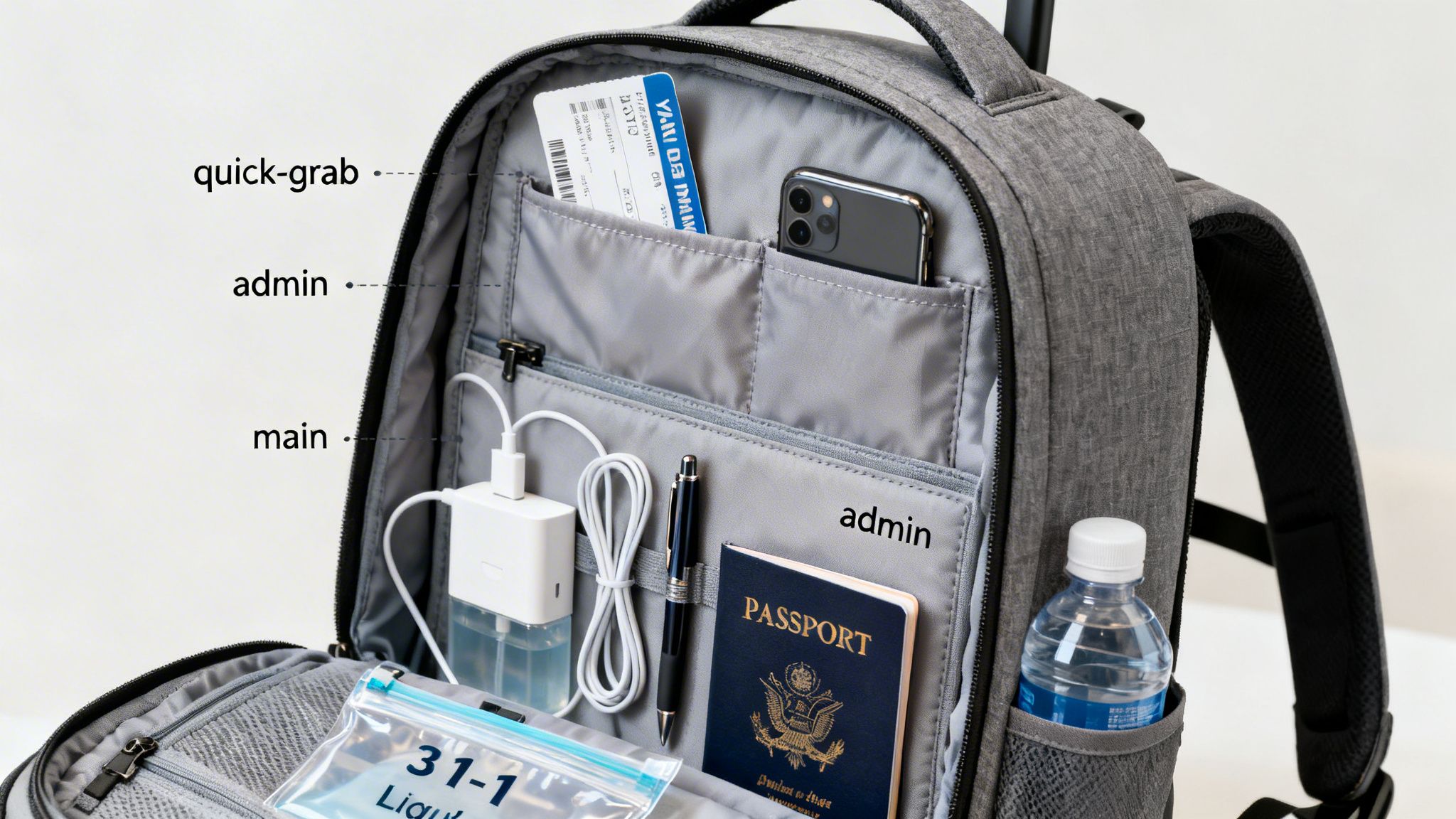
Mapping Your Backpack Zones
Let's break down the real estate of a typical backpack. When you give each pocket a purpose, you're not just stuffing things in—you're organizing for how you'll actually use them on the go.
-
The Top Pocket (The Quick-Grab Zone): This little pocket is your best friend. It’s for anything you need in a hurry: wallet, phone, keys, boarding pass, earbuds. If you’ll need it while standing in line or sitting on the train, it goes here.
-
Side Pockets (Hydration and Weather): One side is almost always for a reusable water bottle. Use the other for a small umbrella or a rolled-up rain jacket. This is a great way to keep potentially damp items away from the dry stuff inside.
-
Front Admin Panel (Your Mobile Office): This is where all your small-but-important gear lives. Think chargers, power banks, pens, a small notebook, and other tech accessories. It stops your cords from turning into a tangled mess at the bottom of your bag.
This kind of built-in organization is why the travel bag market is booming, hitting USD 18.78 billion in 2023. People want smart compartments that make packing easier. And with U.S. trips hitting 2.3 billion last year, organized packing isn’t just a nice-to-have, it’s a must.
The Main Compartment and Security Essentials
The main compartment is the heart of your pack, holding your clothes and shoes (hopefully in packing cubes!). But one of its most important jobs is carrying your bag of liquids.
Always keep your 3-1-1 liquids bag right at the top of the main compartment. When the TSA agent calls out for liquids, you want to be able to grab it in five seconds, not five minutes. This one simple habit will make you a pro in the security line.
A good system isn't just about convenience; it’s a core travel skill. Creating thoughtful packing lists for camping and other trips can make your prep work a breeze, ensuring you don’t forget anything critical. When you know exactly where everything is, you can move through the world with a lot more confidence and a lot less stress.
Now, let's look at how this all comes together with some sample packing lists.
Sample Packing Lists for Different Travelers
To give you a better idea of how to apply these principles, here are a few examples of what you might pack for different kinds of trips.
| Item Category | Weekend Getaway (3 Days) | Business Trip (5 Days) | Adventure Travel (2 Weeks) |
|---|---|---|---|
| Clothing | 2-3 tops, 1-2 bottoms, 1 versatile jacket | 3-4 shirts, 2 slacks/skirts, 1 blazer, 1 casual outfit | 4-5 moisture-wicking shirts, 2 hiking pants, 1 rain jacket, thermal layers |
| Footwear | 1 pair of walking shoes, 1 pair of dressier shoes | 1 pair of dress shoes, 1 pair of comfortable flats/loafers | 1 pair of hiking boots, 1 pair of casual/camp shoes |
| Toiletries | Travel-sized essentials (toothbrush, toothpaste, deodorant, shampoo) | Full toiletry kit with business-appropriate items (razor, styling products) | Biodegradable soap, sunscreen, insect repellent, first-aid kit |
| Electronics | Phone, charger, portable power bank | Laptop, phone, all necessary chargers, portable power bank, adapter | Phone, power bank, headlamp, camera, GPS device or satellite phone |
| Documents | ID, credit cards, reservation confirmations | ID, passport (if international), business cards, meeting notes | Passport, visas, travel insurance, local currency, offline maps |
| Extras | Small book, sunglasses | Portable steamer, travel iron, professional notebook | Water filter/purifier, multi-tool, dry bags, compass |
These lists are just a starting point, of course. The key is to adapt them to your specific destination, activities, and personal style.
Final Security and Airline Compliance Checks
You’ve packed like a pro, and everything has its place. Now for one last check to make sure your trip through the airport is as smooth as possible. This final once-over is all about avoiding those stressful, last-minute surprises at the check-in counter or security line.
Before you head out the door, give your bag a quick physical inspection. Yank on the straps and give the zippers a good pull. You want to spot any potential weak points now, not when you’re sprinting through a terminal to catch a connecting flight.
Secure Your Gear Smartly
You don't need a fortress on your back, but a little smart security goes a long way. A simple TSA-approved lock on the main compartment zippers is often enough to deter anyone looking for an easy grab. It sends a clear message: this bag isn't worth the trouble.
Think strategically about where you put your most important items. Your wallet, passport, and phone should never live in those easy-to-reach outer pockets—they’re a pickpocket's dream in a crowded airport. Tuck them away in an internal pocket or a hidden compartment that sits against your back.
Final Checkpoint: Before you do that final zip, take five seconds for a mental run-through. Passport handy? Phone charged? Liquids bag accessible? This quick habit can save you from a world of frantic digging later on.
Navigate Airline Rules with Confidence
Nothing adds stress to a trip like getting hit with unexpected baggage fees. Every airline has its own quirks, but they all have strict carry-on size and weight limits. Don't eyeball it. Break out a measuring tape and a luggage scale at home to confirm you’re within the limits.
The same logic applies if you're traveling with a furry friend—always double-check the specific airline approved pet carrier dimensions well in advance.
Of course, the big one is the 3-1-1 liquids rule. All your liquids and gels must be in containers of 3.4 ounces (100 milliliters) or less. And all of those tiny bottles need to fit into a single, clear, quart-sized bag.
One of my favorite travel hacks is to switch to solid toiletries. Shampoo bars, conditioner bars, and solid perfumes don't count toward your liquid allowance, which frees up a ton of space in that little plastic bag. For a complete breakdown, our guide on how to pack toiletries for air travel will get you through security without a single issue.
Got Questions About Packing a Backpack? We’ve Got Answers.
Even after you’ve nailed down the basics, a few tricky questions always come up. It’s those little details that can make or break your packing system. Let’s tackle some of the most common ones I hear from fellow travelers.
Getting these right will give you that final boost of confidence before you head out the door.
What's the Best Way to Pack a Backpack and Maximize Space?
There's no single magic trick, but a handful of smart techniques used together will make a huge difference. If you want to use every last inch of your pack, you need a solid strategy.
- Packing Cubes Are Essential: Seriously, don't leave home without them. They turn your jumbled clothes into neat, compressible blocks that you can stack like Tetris.
- The Rolling Method Wins: Tightly rolling things like T-shirts, pants, and shorts squeezes the air out and dramatically reduces their footprint. It also helps keep major wrinkles at bay.
- Fill Every Single Gap: Never let dead space win. Stuff your socks, underwear, or even your bag of chargers right inside your shoes.
Think of it less like stuffing and more like engineering your space. This approach is the difference between a bag that’s straining at the seams and one that zips up smoothly with room to spare.
How Heavy Should My Packed Travel Backpack Be?
This is a big one for your comfort and health. As a rule of thumb, your fully loaded backpack shouldn't weigh more than 10-15% of your body weight. So, if you weigh 150 lbs (68 kg), aim to keep your pack between 15 and 22.5 lbs (roughly 7-10 kg). Trust me, your back and shoulders will thank you.
Don't forget that airlines have their own rules, too. Most carry-on weight limits hover around 7-12 kg (15-26 lbs). Staying in that sweet spot not only saves you from surprise baggage fees but also makes sprinting through an airport much, much easier.
Are Packing Cubes Really Worth It for a Backpack?
Yes, a thousand times yes. Packing cubes are a total game-changer, especially if you have a panel-loading backpack that opens like a suitcase. They essentially work like a set of portable drawers.
Imagine having a cube for shirts, one for bottoms, and another for underwear. You can grab exactly what you need without digging through and destroying your perfectly packed bag. For an extra edge, get your hands on compression cubes. They have a second zipper that squishes everything down, saving you even more space.
How Do I Pack Shoes Without Getting My Clothes Dirty?
It's a classic problem with a simple fix: never let the dirty soles of your shoes touch your clean clothes. Just make sure they’re covered before you tuck them into your pack.
Here are a few easy ways to do it:
- A dedicated shoe bag: Reusable, effective, and made for the job.
- A plastic grocery bag: The free and surprisingly durable option.
- A disposable shower cap: Just stretch it over the soles to contain any dirt or grime.
Once they're wrapped up, slide your shoes along the bottom or sides of the main compartment, with the soles facing away from your clothes. This also helps create a solid, stable base for everything else you're packing on top.
Ready to find the perfect travel companion for your next adventure? At Voyage Luggage, we've curated a collection of the world's best backpacks and travel gear to make every trip smoother. Shop our premium selection and pack smarter. https://voyageluggage.com
Share:
Your Guide to Finding the Perfect International Carry On
What Is a Weekender Bag? The Definitive Travel Guide