

The secret to how to pack light isn’t about owning less; it’s about owning smarter. It’s a complete mindset shift—moving away from the "just in case" clutter and embracing a "just what's needed" philosophy. The whole idea is to build a travel kit where versatile, multi-purpose items work in perfect harmony.
The Mindset Shift to Master Carry-On Travel

Learning how to pack light is less about following a strict checklist and more about adopting a new way of thinking. Your luggage shouldn't be a bottomless pit you cram full. Instead, see it as a curated system designed for freedom and efficiency. This simple change transforms your entire journey before you even walk out the door.
The real goal is to move with ease, breeze through airports, and completely eliminate the dread of lost luggage. Ask any seasoned traveler, and they'll tell you the feeling is liberating. Imagine strolling from the airport to your hotel, hopping on local transport without a fight, and never again paying an unexpected baggage fee.
To get there, it helps to break down the approach into three core principles. Mastering these will fundamentally change how you prepare for any trip, whether it's a weekend business conference or a two-week international adventure.
The Three Pillars of Packing Light
| Pillar | Core Principle | Key Action |
|---|---|---|
| Mindset | Intentionality over "what ifs" | Pack only for confirmed plans, not for every possible scenario. Be realistic. |
| Gear | Versatility is everything | Choose items (clothing, tech) that serve multiple purposes and mix and match easily. |
| Technique | Maximize every inch | Use smart packing methods like rolling and packing cubes to create space. |
Think of these pillars as the foundation of your new packing strategy. They work together to create a system that's both efficient and incredibly freeing.
The core idea is simple: everything you pack should earn its place in your suitcase. If an item only works for one specific outfit or a single, unlikely situation, it probably shouldn't make the cut.
This intentional approach comes with a fantastic side effect. Embracing a minimalist mindset on the road goes beyond personal convenience; it's also a great way to reduce your environmental impact. To explore this further, you can learn how to travel sustainably. Lighter bags mean less fuel consumption on planes and make using public transit a breeze.
From Overwhelmed to Organized
Think about your past trips. Have you ever found yourself dragging a heavy suitcase across cobblestone streets? Or maybe you've spent ten minutes digging through your bag just to find a phone charger. These common travel frustrations are just symptoms of overpacking.
The solution is to trade that chaos for control. By carefully curating your items and organizing them smartly, you create a travel system that works for you, not against you. This guide will walk you through the practical steps to get there, turning packing from a dreaded chore into a satisfying art form.
Finding the Right Gear to Build Your Travel System
Your carry-on is more than just a bag; it's the cornerstone of your entire travel setup. Choosing the right one is the first real step you'll take toward mastering the art of packing light. This decision isn't about fancy brand names—it's about finding a core piece of equipment that genuinely works for you on every leg of your journey.
Think of your main bag as your mobile command center. Everything you bring has to live inside it, so getting to know its features and, more importantly, its limits is crucial. You’ll generally find two main camps: hardside and softside luggage. Each has its own personality and clear advantages, depending on how and where you travel.

Hardside vs. Softside Carry-Ons
The hardside-versus-softside debate often comes down to personal taste, but certain travel styles really make one a clear winner over the other.
A hardside suitcase, usually built from tough but light polycarbonate or aluminum, offers the best protection for whatever you’re packing. This makes it a fantastic choice if you're hauling fragile souvenirs, camera equipment, or just want that extra peace of mind. Their rigid shells are also a great defense against the elements, keeping your things dry if you get caught in the rain.
On the flip side, softside luggage is all about flexibility. The biggest perk? Those exterior pockets. For a business traveler, they’re a complete game-changer, letting you grab a laptop or documents without having to splay your entire suitcase open on the airport floor. The fabric also has a bit more "give," which is perfect for squeezing in that one last thing you bought.
A Real-World Example: I once took a hardside with four spinner wheels on a multi-city European trip, and it was a lifesaver. It glided over cobblestone streets and protected my belongings on bumpy train rides. But for a quick domestic business trip last month, my two-wheeled softside was perfect—I kept my laptop in the front pocket for easy access and it slid into a crowded overhead bin without a fight.
Ultimately, the best bag is the one that fits the kind of travel you do most. Think about the destinations, airlines, and activities that usually fill your calendar.
Your Packing Accessory Toolkit
Once you've landed on the right bag, it's time to organize the inside. This is where a few key accessories can turn the empty cavern of your suitcase into a perfectly ordered system. Honestly, learning how to pack light is impossible without these tools.
The undisputed champion here is the packing cube. These simple zippered containers do so much more than just keep clothes neat—they also compress everything, letting you fit more into the same amount of space.
- Group by Category: This is the classic method. Use one cube for tops, another for bottoms, and a smaller one for socks and underwear. Simple and effective.
- Pack by Outfit: For shorter trips, I love packing a full day's outfit into a single cube. You can just grab one each morning and you’re ready to go, no thinking required.
- Quarantine Your Laundry: Always bring an extra, empty packing cube. It becomes your mobile hamper, keeping dirty clothes sealed away from the clean stuff.
Beyond cubes, a couple of other organizers have become non-negotiable for me. A dedicated tech organizer is a must for anyone with more than just a phone. It’s a little pouch with loops and pockets that wrangles all your cables, power banks, and adapters. It single-handedly ends the frustrating ritual of digging through a tangled nest of wires just to charge something.
Finally, a quality, clear toiletry bag is your ticket to a faster security screening. When agents can see what's inside a TSA-approved bag, they don't have to rummage through your personal items. I always recommend getting one with a sturdy zipper and waterproof material—it's cheap insurance against shampoo explosions. These small investments in organization pay you back tenfold in saved time and avoided stress.
Building Your Travel Capsule Wardrobe
Mastering the art of packing light really comes down to building a smart travel capsule wardrobe. This isn't about restricting yourself; it's about making your style work harder for you. A capsule wardrobe is your best-kept secret for looking put-together with just a handful of items, where every single piece is chosen because it plays well with others.
The whole point is to curate a small, versatile collection of clothes you can mix and match into a surprising number of outfits. It’s what frees you from that "I have nothing to wear" panic, even when you’re living out of a carry-on for a week. The trick is to stick to a cohesive color palette and choose high-performance, multi-functional fabrics.
The Foundation of a Great Capsule
The first step is always the color palette. I like to think about it in terms of a foundation and some pops of personality.
- Base Colors: Start with one or two neutral colors that you know look good on you and work well together. Think navy, black, gray, or a classic tan. These will form the backbone of your travel wardrobe—your trousers, jackets, and main pair of shoes will all come from this family.
- Accent Colors: Next, pick two or three complementary colors to bring your outfits to life. This is where your shirts, scarves, and other accessories come in. This simple structure guarantees that almost any top you grab will match any bottom you’ve packed.
For example, a palette of navy and gray as your bases, with accents of crisp white, soft blue, and a rich burgundy, gives you a timeless and incredibly flexible foundation. Suddenly, everything coordinates without you even having to think about it.
A well-planned capsule wardrobe isn't restrictive; it’s empowering. It proves that with just 10-12 carefully selected pieces, you can create over two weeks of unique, stylish outfits for any occasion.
This entire approach is designed to be flexible. The formula stays the same, but the specific items you pack will change based on your destination and what you’ll be doing. It’s all about being intentional with every item that earns a spot in your bag.
Scenario-Based Outfit Formulas
Let's look at how this plays out in the real world. A truly successful capsule relies on simple, repeatable formulas that give you maximum style with minimum fuss.
Scenario 1: Five-Day Business Trip For a work trip, efficiency and polish are everything. Here’s a simple formula that can deliver a week's worth of sharp outfits from just a few key pieces.
- Outerwear (1): A classic navy blazer.
- Bottoms (2): One pair of tailored gray trousers and one pair of black chinos.
- Tops (3): Two button-down shirts (one white, one light blue) and one high-quality merino wool sweater.
With just those six items, you can create distinct looks for every day. Wear the blazer and trousers for a big presentation, then switch to the sweater and chinos for a more casual client dinner. Each piece works with at least two others, which multiplies your options instantly.
Scenario 2: Week-Long Coastal Vacation When it’s time for leisure, comfort and versatility are what matter most. You need clothes that can take you from the beach to a nice dinner without requiring a full costume change.
- Light Layers (2): A breathable linen shirt and a lightweight sweater.
- Bottoms (1): A pair of tailored shorts.
- Versatile Staples (2): A simple, elegant dress and a pair of dark-wash jeans.
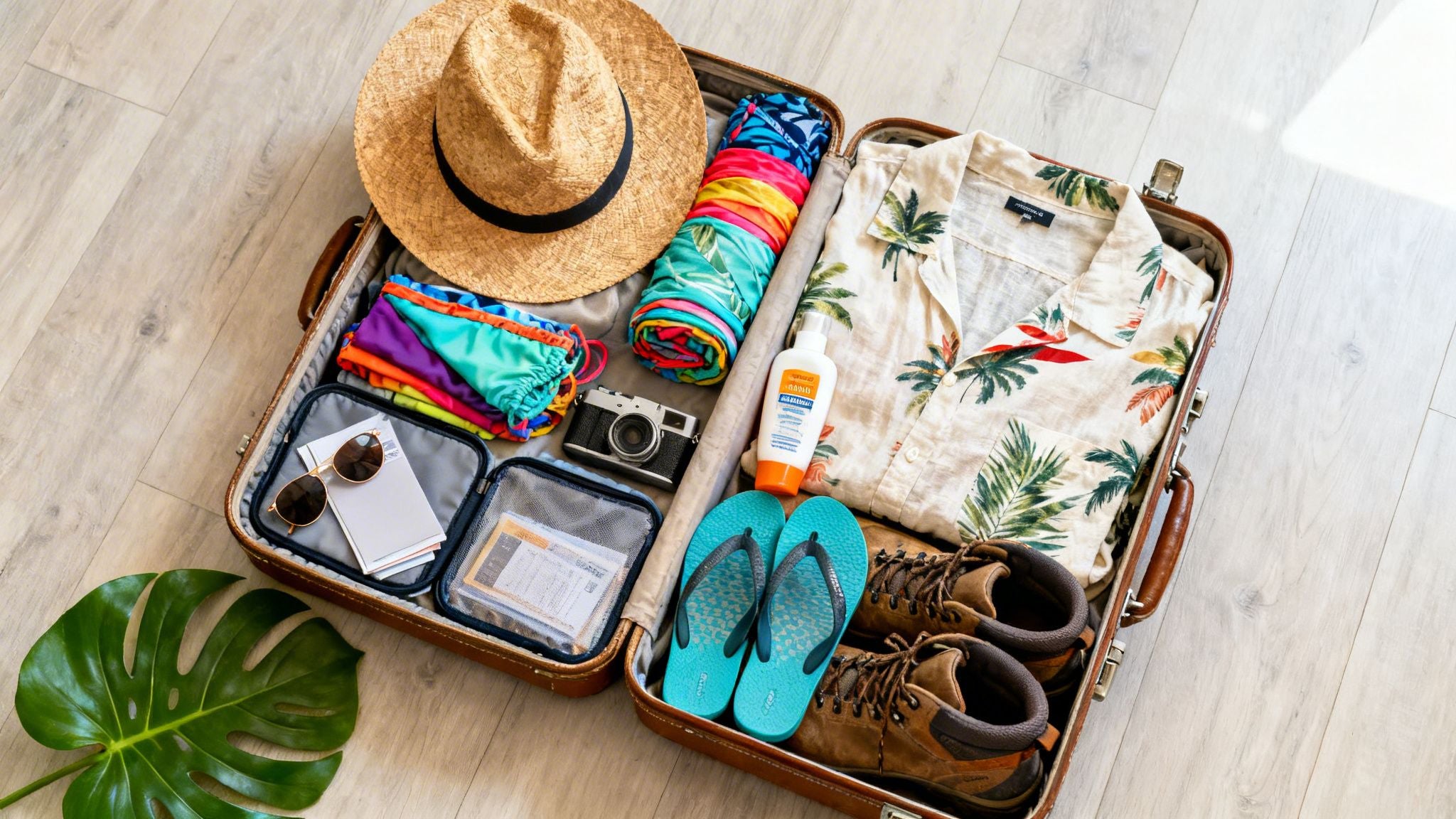
This tiny collection lets you mix and match for whatever the day brings. The linen shirt can be a beach cover-up or a top for exploring town. The sweater can be thrown over the dress for a cool evening. It just goes to show how a few smart choices can set you up for a whole week of adventure. For more ideas on what to pack, check out our guide on the top packing essentials for minimalist travelers.
Prioritize High-Performance Fabrics
The final piece of the capsule puzzle is your choice of fabric. Honestly, this is what separates a good travel wardrobe from a great one. The right materials will keep you comfortable, fresh, and looking sharp without a wrinkle in sight.
When you're curating your items, always look for adaptability. For instance, multi-functional neck gaiters are a perfect example of this spirit—they can be a scarf, a headband, or even a face covering, all in one small package.
Beyond that, here are the game-changing fabrics I always look for:
- Merino Wool: This natural fiber is a traveler's best friend. It’s incredibly soft, helps regulate your body temperature in both hot and cold climates, and is naturally odor-resistant. That means you can wear a merino wool shirt or sweater multiple times between washes.
- Technical Blends: Keep an eye out for fabrics made with Tencel, modal, or certain polyester blends. These materials are specifically designed to be wrinkle-resistant, quick-drying, and durable—perfect for life on the road. You can give them a quick wash in the hotel sink, and they’ll often be dry by morning.
Mastering the Art of the Carry-On
You’ve curated your capsule wardrobe and picked the perfect carry-on. Now for the fun part: fitting it all in. This is where we move beyond the usual advice and get into the techniques that seasoned travelers use to make every inch count. This isn’t about just stuffing things in; it’s about creating an organized, easy-to-access system within your bag.
Forget the one-size-fits-all approach. While rolling clothes is a fantastic starting point, it’s not the answer for everything. The real secret is tailoring your packing method to the specific garment.
To Roll or To Fold? That Is the Question
For your soft, wrinkle-resistant clothes, rolling is king. Think t-shirts, knitwear, jeans, and activewear. Rolling these items tightly does two things brilliantly: it compresses them down to save a surprising amount of space and helps sidestep those stubborn creases.
But what about your more structured pieces? For these, folding is your friend. A crisp button-down shirt, a structured blazer, or freshly pressed trousers will arrive in much better shape if you give them a clean, flat fold. Trying to roll these can actually introduce more wrinkles and ruin their form. You have to respect the structure of the garment.
This little diagram breaks down how to build that versatile travel wardrobe before you even think about packing.

See how it all starts with a core color palette? That simple choice is the foundation for a suitcase where everything works together.
If you’re traveling for business or packing more delicate items, you need to know about the bundle wrapping method. It’s a complete game-changer. You start with a soft “core,” like a small packing cube with your underwear or t-shirts. Then, you lay your most delicate garment—say, a suit jacket or a silk dress—out flat and wrap it around that core, layering other clothes as you go. This creates gentle curves instead of sharp, set-in creases. You’ll arrive looking polished, not rumpled.
Why Packing Cubes Are Your Secret Weapon
Packing cubes get a lot of credit for organization, but their real superpower is compression. When you use them right, you can shrink down your clothes and reclaim a serious amount of space in your luggage. Finding the best packing cubes for travel for your specific needs can make a world of difference.
Here’s how to get the most out of them:
- Roll with intention. Don’t just loosely roll your clothes; make each one as tight and compact as you can before placing it in the cube.
- Leave no space behind. Pack the rolled items snugly side-by-side. Think of it like a puzzle—the goal is to eliminate empty air pockets.
- Press and zip. As you close the cube, use your free hand to press down on the contents, squeezing out any remaining air. If you have compression cubes with that second zipper, this is their moment to shine.
Once they're packed, your cubes become modular blocks. I like to play a little game of Tetris with them in my suitcase, placing the larger, heavier cubes at the bottom and slotting the smaller ones into the gaps. This creates a stable, dense pack that won't shift around, no matter how much it gets tossed about.
Pro Tip: Never waste "dead space." Those empty shoes? They're perfect for stuffing with socks, chargers, or other small odds and ends. It’s like finding free real estate in your bag.
Finally, think about your path through the airport. I always place my clear liquids bag and my laptop in an outer pocket or right on top. This little bit of foresight makes the security line a breeze. No more frantic digging while everyone behind you waits. Just a smooth, quick transition on your way to the gate.
Taming Your Tech and Toiletries
After you've nailed down your wardrobe, the next biggest hurdle is often the jumble of toiletries and electronics. These things are heavy, awkward, and have their own set of travel rules—think TSA liquid limits and that tangled mess of cables. But getting this part right is a game-changer. It declutters your bag and, honestly, your mind.
My strategy boils down to two simple goals: go solid with toiletries whenever you can, and consolidate all your chargers. This approach doesn't just save a surprising amount of space and weight; it makes your life on the road so much easier. Less time spent fumbling with cords means more time actually enjoying where you are.
Conquer Your Toiletry Kit with Solid Swaps
Liquids are the sworn enemy of the carry-on traveler. They’re heavy, take up precious real estate, and always seem to be plotting a disastrous leak all over your favorite shirt. Luckily, the rise of solid toiletries is our secret weapon.
Making the switch to solid products is one of the easiest wins you'll get. I've found these swaps to be incredibly effective:
- Shampoo and Conditioner Bars: A single, tiny bar can do the work of a full-sized bottle, lasting for weeks without adding bulk. Best of all, they don't count towards your liquid allowance.
- Toothpaste Tablets: Forget bulky tubes. These little chewable tabs are a revelation. Just pop one in, chew it into a paste, and brush like normal with a wet toothbrush.
- Solid Perfume or Cologne: A small tin of solid fragrance is way more practical than a delicate glass bottle. It's durable, compact, and you never have to worry about it shattering.
Here's a real-world impact: By swapping just three items—shampoo, conditioner, and toothpaste—to their solid versions, you can instantly free up enough room in your clear liquids bag for essentials like sunscreen or a special face wash. All this, and you eliminate the risk of a gooey mess.
This strategy is all about building a smarter, TSA-friendly toiletry kit. For a deeper look at getting your liquids and other essentials perfectly organized, our complete guide on how to pack toiletries for air travel has even more tricks. The end goal is a small, leak-proof system that sails through security.
Embrace the 'One Charger' Philosophy
Let's be real. It's so easy to end up with a charger for your phone, another for your laptop, one for your headphones, and maybe a fourth for your watch. This charger chaos adds up fast, creating a heavy, tangled nightmare in your bag. The fix? One charger to rule them all.
This is where a good Gallium Nitride (GaN) charger becomes your best travel companion. These modern marvels are way smaller and more powerful than the old silicon bricks we're used to. A single GaN charger with a few USB-C and USB-A ports can power up your laptop, phone, and earbuds all at once, from just one outlet.
Instead of packing three or four separate power bricks and all their cables, you just pack one. It's a tiny change that has a massive impact on your packing game.
Get Your Digital Kit in Order
Once you've consolidated down to one charger, the final piece of the puzzle is organizing what's left. A slim tech organizer is non-negotiable if you’re carrying more than just a phone. These pouches use a smart system of elastic loops, zippered pockets, and dividers to keep everything in its place.
Here’s what my go-to tech kit looks like:
- My one GaN charging brick.
- The essential cables for my devices (I try to find interchangeable ones).
- A slim portable power bank for those moments when an outlet is nowhere in sight.
- Any international travel adapters needed for my destination.
By keeping all your tech in one spot, you’ll never have to tear apart your suitcase looking for a cable again. It’s a simple system that ensures your gear stays charged, your bag stays tidy, and you can focus on the adventure ahead.
Getting Through the Airport and Staying Fresh
Packing the perfect carry-on is one thing, but getting it onto the plane without a hitch is another entirely. The last thing you want is for your meticulously packed bag to be flagged at the gate for being too big or too heavy.
Airline rules for carry-on luggage can vary dramatically. What flies on a major international carrier might get you hit with hefty fees on a budget airline. The rules can even change from one year to the next.
Before you even think about leaving for the airport, take two minutes to check your airline’s website. I do this for every single flight. Look up their current carry-on dimensions and weight limits. A small, digital luggage scale is one of the best investments a frequent traveler can make; it’s saved me from stressful repacking at the check-in counter more times than I can count.
The Secret to Staying Clean on the Road
So, what happens a few days into your trip when your favorite shirt isn't so fresh anymore? This is where a lot of people's light-packing plans fall apart. But living out of a carry-on doesn't mean you have to lower your standards for cleanliness. All you need is a simple laundry plan.
The real magic of packing light is re-wearing your clothes. A quick sink wash every couple of nights with a travel-friendly detergent is all it takes to keep your key pieces clean and ready for whatever comes next.
This little routine takes maybe 10-15 minutes but prevents laundry from becoming a major headache. For longer trips, you’ve got a couple of fantastic options.
-
Detergent Sheets: Forget about messy liquid or bulky pods. These paper-thin, water-activated sheets are a traveler's dream. They're practically weightless and make washing a few items in a hotel sink incredibly easy.
-
Local Laundry Services: In many places, especially across Asia and South America, you'll find "wash and fold" services that are surprisingly cheap and fast. Dropping off a bag of clothes in the morning and getting it back, clean and folded, by dinnertime is a common and wonderful reality.
Thinking through these simple logistics is what turns a one-week carry-on strategy into a plan that can last for months. It’s how you stay feeling fresh and collected, no matter how long you're on the road.
Your Top Packing Light Questions Answered
Making the switch to carry-on-only travel is a game-changer, but it’s natural to have a few nagging questions. After all, the theory is one thing, but dealing with real-world travel curveballs is another. Let's tackle some of the most common "what ifs" so you can pack and travel with complete confidence.
One of the biggest fears is getting to the gate and finding your carry-on is overweight. Don't panic. The first thing to do is wear your heaviest items. That bulky sweater, your jacket, those boots? Put them on. You can also shift small, dense items like a power bank or a book into your jacket pockets until you're on the plane. It's an old trick, but it works every time.
Another common puzzle is packing for multiple climates in one small bag. The secret is simple: layering.
How Do I Pack for Different Climates in One Bag?
Packing for both a sunny beach and a chilly mountain town seems impossible, but it's all about thinking in systems, not single items. Forget the bulky parka; a smart layering system is far more versatile and saves a ton of space.
- Your Base: Start with a few lightweight, moisture-wicking tops. These are perfect on their own in the heat but also serve as the foundation for warmth.
- Your Mid-Layer: Add a versatile piece for insulation. A merino wool sweater is a fantastic choice, as is a lightweight fleece.
- Your Outer Shell: Top it all off with a packable, waterproof shell jacket. This will be your shield against wind and rain.
With these three layers, you can mix and match to handle almost any weather. Just add or remove a layer as the temperature changes throughout the day. It’s incredibly effective.
The biggest mistake I see people make is packing for "what if" scenarios instead of what's actually on their itinerary. Don't bring a heavy snow coat for one cold day on an otherwise warm trip. Trust your layering system—it's almost always enough.
Finally, let's settle the great debate: rolling versus folding. The truth is, you need both. Rolling is brilliant for compressing soft, wrinkle-resistant clothes like t-shirts, workout gear, and knits. But for anything structured that creases easily, like a blazer or a collared dress shirt, a neat fold is the way to go. Using a combination of the two is the real key to a perfectly packed bag.

Share:
How to Fix Broken Luggage Handle: A Practical DIY Guide
Briggs and Riley Lifetime Guarantee Your Complete Guide