

The best TSA-approved luggage locks give you that perfect mix of tough security and travel compliance. Top-tier brands like Master Lock, Forge, and TravelMore are known for their reliability, often using features like hardened steel shackles and combinations you can set yourself. They keep your gear safe while letting security do their job without breaking your lock.
Why TSA-Approved Locks Are a Travel Essential
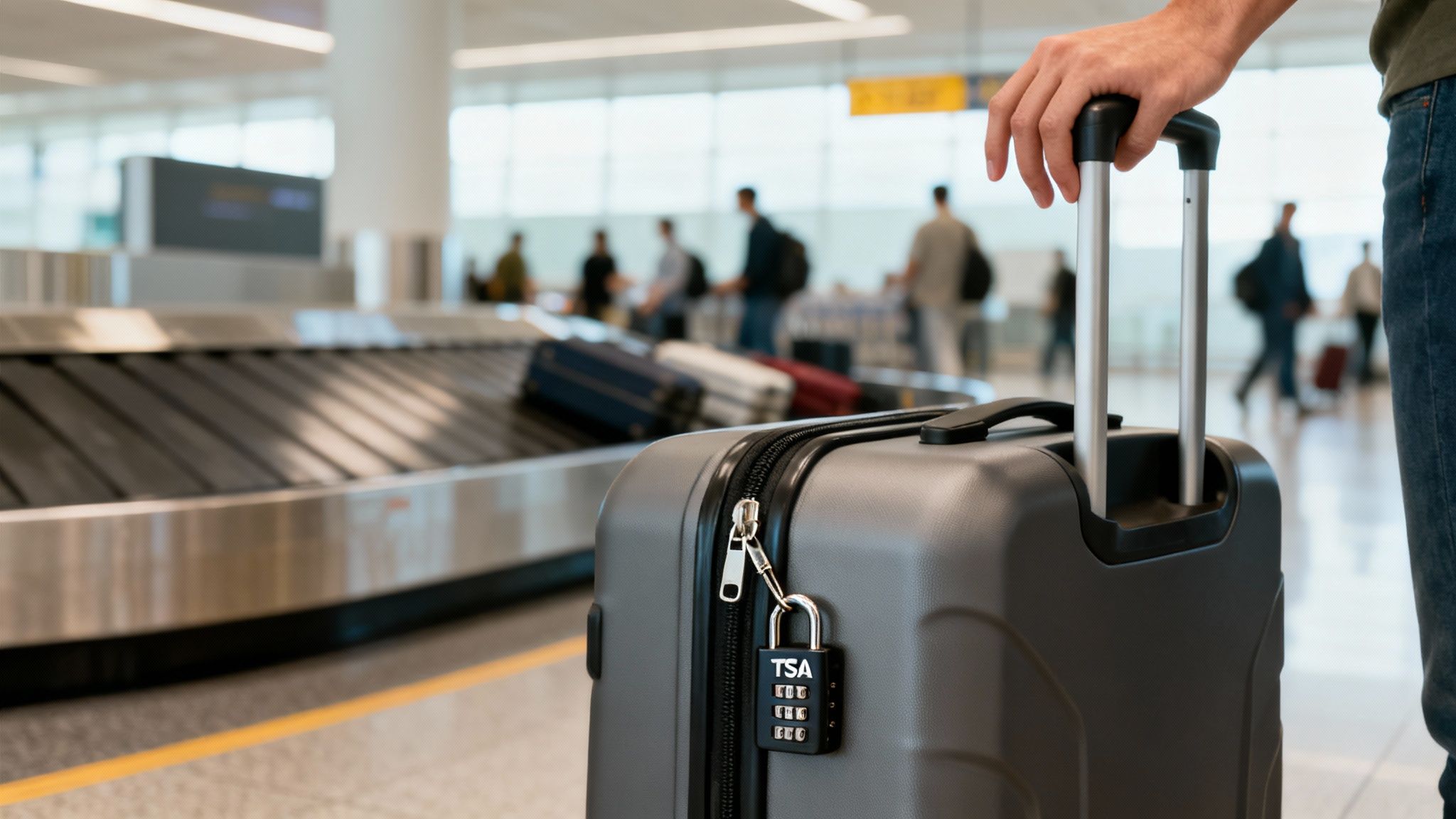
We’ve all been there: standing at the baggage carousel, watching bag after bag go by, with a growing knot in our stomachs. The anxiety boils down to one simple question: "Are my things safe?" This is exactly why a TSA-approved lock isn't just a gadget; it's a non-negotiable part of your travel gear.
Peace of Mind Meets Practicality
Think of a TSA lock as a special handshake between you and airport security worldwide. You get to lock up your bag with your own key or secret code. At the same time, it gives agents from the Transportation Security Administration (TSA)—and similar agencies in over 75 countries—a way to open your bag for inspection using a master key, without having to break anything.
If you use a regular, non-approved lock, security agents are left with no choice. They’ll have to cut it off or even break your zippers to get inside. Once that happens, your bag is wide open and vulnerable for the rest of its trip, from the tarmac to the hotel. A TSA-recognized lock ensures that if your bag is inspected, it gets relocked securely afterward.
Warding Off Opportunistic Theft
Let's be real: no lock is completely impenetrable. But a good TSA-approved lock is an excellent deterrent against the most common type of travel theft—the crime of opportunity. It sends a clear signal to would-be thieves in busy airports or on transport that your bag isn't an easy target. Most will simply move on to find an unsecured bag.
Protecting your belongings is just one part of staying safe. For a deeper dive into travel security, check out our guide on decoding travel scams and staying safe abroad.
The core benefit of a TSA-approved lock is simple: it secures your belongings from criminals while ensuring you remain compliant with security agencies. This dual function prevents damage and maintains your privacy as much as possible during inspections.
Ultimately, using one of the best TSA-approved luggage locks lets you focus on the adventure ahead, not on what’s happening to your suitcase behind the scenes.
How TSA-Approved Locks Actually Work
So, what’s the secret sauce behind these special locks? Let's use a simple analogy. Think of a TSA-approved lock like the door to your hotel room. You have your key card or code to get in anytime you want, but the hotel staff has a master key. This master key isn't for just anyone—it’s for management to use for cleaning or emergencies.
In the world of travel, the Transportation Security Administration (TSA) is the "hotel management." Your lock keeps your bag secure from anyone else, but it allows authorized TSA agents to perform necessary security checks with their special tools.
This dual-access system is the core principle. When a TSA agent spots the official Travel Sentry or Safe Skies logo on your lock, they know they can open it, inspect your bag, and lock it back up without breaking a thing. It’s a smart balance between your personal security and the airport's need to screen luggage.
The Universal Key System
The real magic is a set of master keys that only security personnel at airports have access to. It’s not just one magic key, though.
Each TSA-approved lock is designed to work with a specific master key, which is why you'll see a small code stamped on it, something like "TSA002" or "TSA007". When an agent needs to inspect your bag, they just match the code on your lock to the corresponding master key in their toolkit.
This simple but effective system means that if your bag gets flagged for a random search, your lock won't be a problem.
A common myth is that there's just one TSA master key. The truth is, there's a whole series of different keys and tools. The code on your lock (TSA002, TSA007, etc.) tells the agent exactly which tool they need to use.
Once the inspection is done, the agent relocks your bag, and it continues on its journey, safe and sound. Without this system, they’d have no choice but to cut your lock off, leaving your bag unsecured and you with a broken lock to replace. For a step-by-step walkthrough, check out our guide on how to secure your luggage with the 3-dial Travel Sentry Combination Lock.
A Global Standard for Security
What really makes these locks a must-have for frequent flyers is their worldwide acceptance. The system that powers most TSA-recognized locks, Travel Sentry, isn't just a US thing—it's been adopted in 75 countries and is used at over 750 airports across the globe.
This means you can fly from New York to London, then hop over to Tokyo, all with the same lock. Security agents in each of those airports will be able to inspect your bag properly without resorting to bolt cutters. For anyone who has invested in good luggage, a snipped lock doesn't just compromise security; it ruins the whole setup.
Choosing Your Perfect TSA Lock Type
Not all TSA locks are created equal, and the right one for you really boils down to your personal travel style. Think of it as balancing convenience, how much security you need, and the kind of bag you’re using. Let’s break down the four main types to help you find your perfect match.
This flowchart gives you a quick visual of what happens at a security checkpoint.
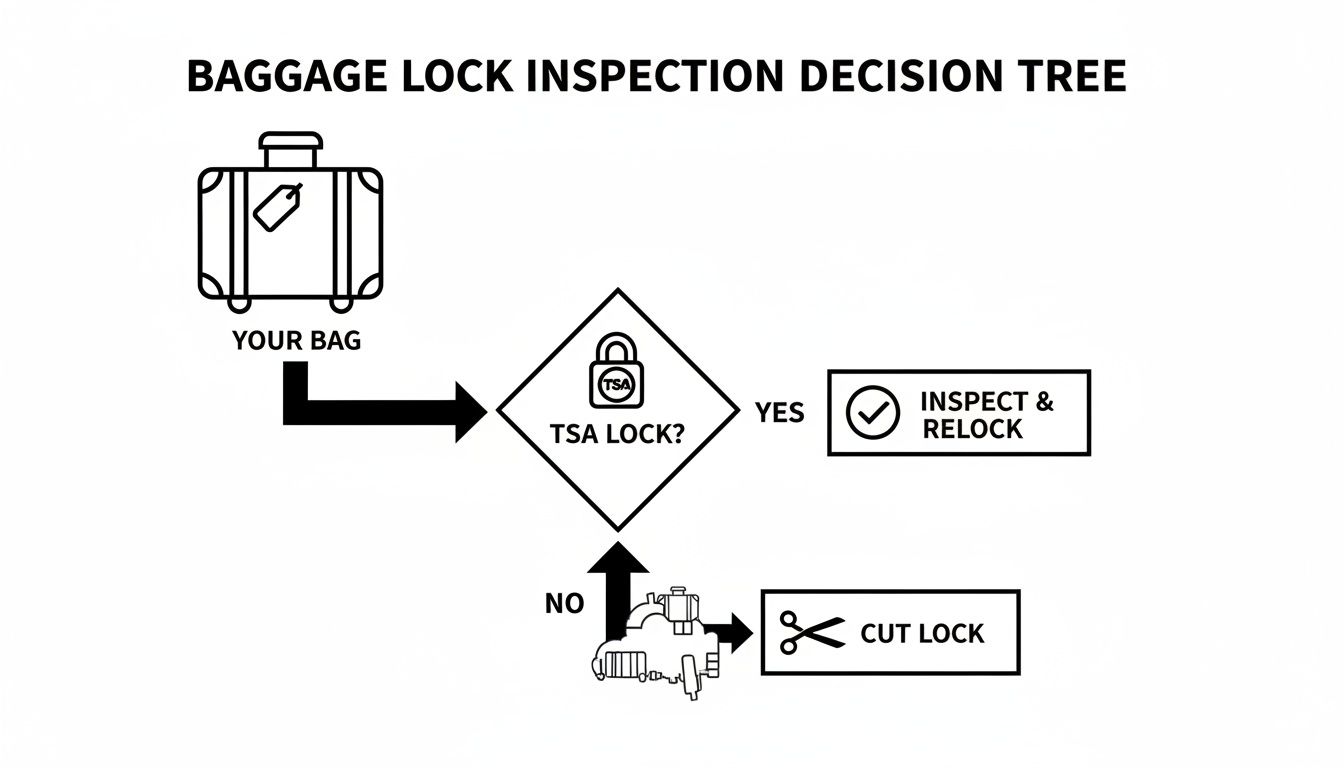
The bottom line is simple: a TSA-approved lock means security can inspect your bag and lock it back up. A non-compliant lock will just get cut off, leaving your stuff vulnerable for the rest of its journey.
Key Locks: The Traditional Choice
Key locks are the classic, no-fuss option we all know. They work just like a standard padlock—turn the key, and you're in. If you're someone who prefers simplicity and doesn't want to memorize another number sequence, these are a fantastic choice.
But there's a catch, and it's a big one. If you lose that tiny key, you’re locked out of your own bag. That’s a massive headache you don’t want, especially when you’re thousands of miles from home.
Combination Locks: The Keyless Convenience
These days, combination locks are the go-to for most travelers. They offer keyless security with a three or four-digit code you can set yourself. That means one less thing to carry around and, more importantly, one less thing to lose. Setting the code is usually a breeze, putting you in control.
The numbers back this up. The global market for TSA-approved locks is huge—valued somewhere between USD 1.2 and 1.375 billion in 2024—and combination locks dominate, making up a whopping 45.5% of that market. It’s clear that travelers love the freedom of not having to track a physical key. You can dig deeper into the luggage lock market trends if you're curious.
Cable Locks: The Flexible Solution
Unlike the rigid, U-shaped shackles on traditional locks, cable locks use a flexible but tough steel cable. This design makes them incredibly versatile. You can easily snake one through multiple zipper pulls on a backpack, secure awkwardly shaped gear, or even tether your bag to a fixed object for a minute.
Their flexibility is their biggest advantage, making them perfect for soft-sided luggage, duffel bags, and backpacks where a standard lock just won't fit. While the cable is strong, it's worth noting that it could be more vulnerable to a determined thief with bolt cutters than a solid steel shackle.
Integrated Locks: The Seamless Security
You'll find these locks built directly into premium hardside and aluminum suitcases from brands like TUMI or Briggs & Riley. They offer a sleek, seamless security solution that you can't misplace because it’s part of the bag itself.
An integrated lock provides the ultimate convenience because it's part of the luggage. You never have to remember to pack it, and its design is inherently more tamper-resistant than a separate padlock.
These locks are almost always combination-based and, of course, have the TSA master keyhole. While they are hands-down the most secure and convenient option, they aren't an accessory you can add later. You have to buy a suitcase that already has one.
TSA Approved Lock Types At a Glance
Feeling a bit overwhelmed by the options? This quick comparison table breaks down the main types to help you zero in on what works best for your travel needs.
| Lock Type | Best For | Pros | Cons |
|---|---|---|---|
| Key Lock | Travelers who prefer simple, traditional security and don't want to remember codes. | Easy to use, no combinations to forget, generally affordable. | The key can be easily lost, locking you out of your bag. |
| Combination Lock | The everyday traveler who values convenience and keyless access. | No keys to lose, customizable code, wide variety of styles. | You have to remember the code; can be forgotten under stress. |
| Cable Lock | Backpackers, duffel bag users, and anyone needing to lock uniquely shaped items. | Highly flexible, can secure multiple zippers or attach to objects. | The cable can be more vulnerable to cutting than a solid shackle. |
| Integrated Lock | Frequent flyers and those investing in premium luggage for maximum security. | Built-in (can't be lost), very secure, sleek and seamless design. | Only available on specific luggage; cannot be added or replaced easily. |
Ultimately, the perfect lock is the one that fits seamlessly into your travel routine. Whether you prioritize the old-school reliability of a key or the modern convenience of an integrated system, there's a TSA-approved lock out there for you.
Key Features That Define the Best Locks
Alright, you know the different kinds of locks out there. But what separates a truly great lock from a merely good one? Think of this as your personal checklist for making a smart buy—the little details that make a huge difference in whether a lock is a trusted travel partner or a frustrating piece of junk.
The first thing to look at is what the lock is actually made of. You want to see high-strength metals like hardened steel or a solid zinc alloy. These materials are tough for a reason: they stand up to cutting, tampering, and the general beating that bags take on their journey. A flimsy plastic lock? That's really just for show.
Durability and Build Quality
The shackle—that's the U-shaped loop or cable part—is always a lock's weakest link. A hardened steel shackle is a game-changer because it makes life incredibly difficult for anyone with a pair of bolt cutters. That extra resistance is what you're paying for. If you're curious about what goes into making a lock genuinely secure, looking into the various lock services and types offered by locksmiths can be really insightful.
Beyond the shackle, the lock body itself should feel dense and solid in your hand, not hollow and cheap. That feeling of weight usually means the internal parts are better made and less likely to jam up or fail when you need them most.
Convenience and User-Friendly Design
A lock can be built like a tank, but if it's a pain to use, you'll end up hating it. The best designs focus on making your life easier, not harder.
Here are a few things to look for:
- Resettable Combination: Being able to set your own code is non-negotiable. It means you can pick something you'll actually remember. Most modern locks, including our own 3-Dial Travel Sentry Combination Lock, make setting the code a breeze.
- Easy-to-Read Dials: There's nothing worse than squinting at tiny numbers in a poorly lit hotel room. Look for locks with large, clear dials that have good contrast. Your eyes will thank you.
- Inspection Indicator: This is a fantastic little feature. It’s a small visual cue, maybe a colored ring or a button that pops up, that lets you know if a TSA agent has opened your lock. It's a simple way to get peace of mind, confirming your bag was inspected and should have been properly re-locked.
Innovation in a Growing Market
It's no surprise that as more people travel, the demand for better security has exploded. The global market for luggage locks is expected to grow by about USD 1.23 billion between 2023 and 2028. What’s really interesting is that TSA-approved locks are growing almost twice as fast as the rest of the market. This surge has pushed manufacturers to get creative, introducing stronger alloys and even locks that connect to your phone.
At the end of the day, the best lock is one you don't think twice about using. It needs to be tough enough to stop a thief but simple enough that it never slows you down. Finding that perfect balance is the key.
Matching a Lock to Your Luggage and Travel Style
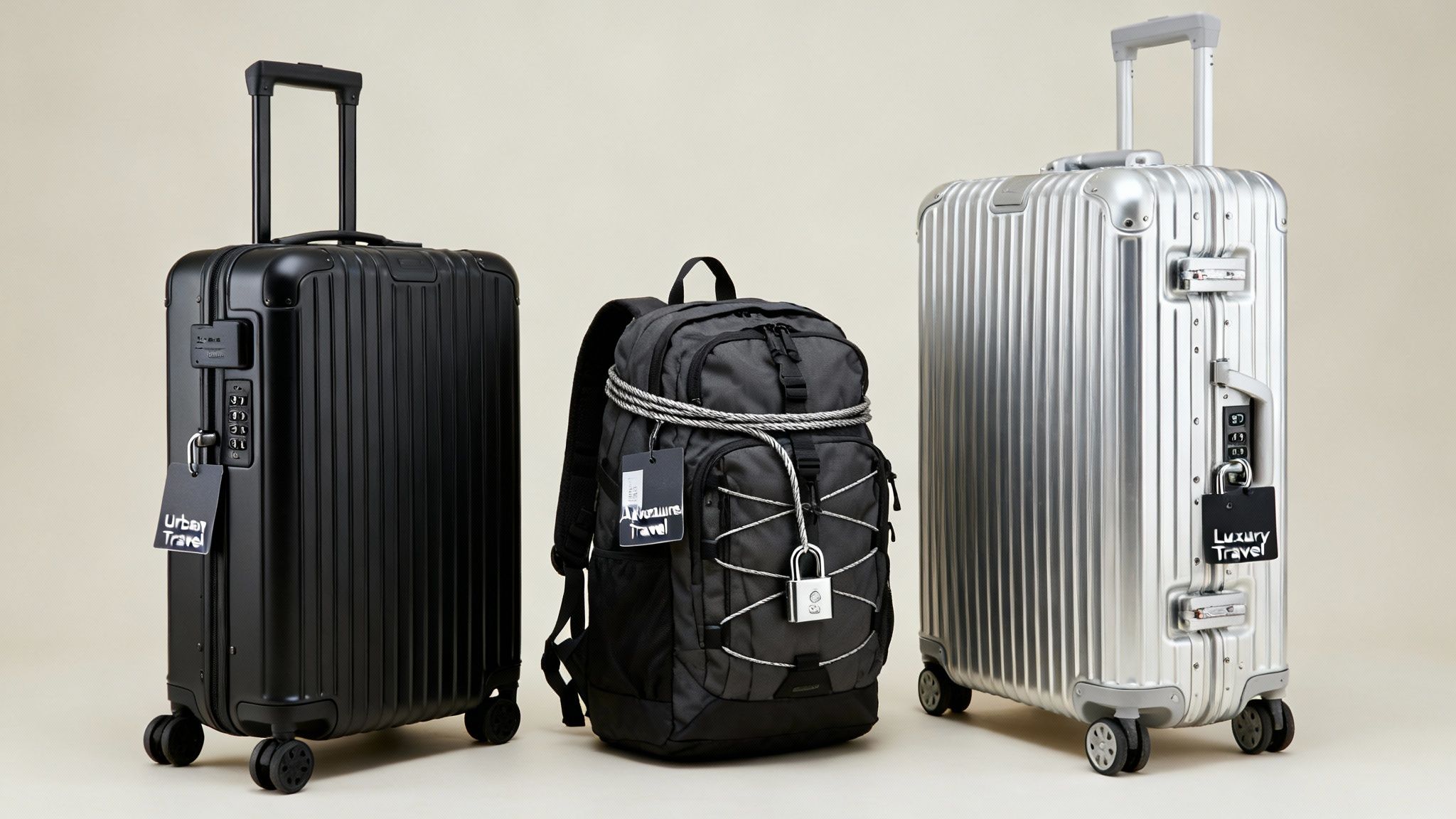
Choosing the right TSA-approved luggage lock isn't just a security decision—it's about finding a piece of gear that fits your travel style like a glove. The sleek lock that works perfectly for a business traveler's carry-on is probably the wrong choice for a backpacker’s rugged pack. When you match the lock to the journey, it becomes an invisible, effortless part of your setup.
Think about what you're carrying and where you're headed. A tough hardside suitcase has different needs than a soft duffel bag with zippers everywhere. The goal is to pick a lock that makes your life easier, not more complicated.
The Frequent Business Flyer
If you’re constantly on the move for work, living out of a carry-on, you need two things: speed and reliability. Your luggage is likely a quality piece from a brand like TUMI or Briggs & Riley, and your lock should live up to that standard. For you, a discreet but strong combination lock is the way to go.
- Luggage Type: Hardside or softside carry-on, laptop bag.
- Recommended Lock: A compact, resettable combination lock built from hardened steel or a zinc alloy. If your suitcase already has an integrated lock, even better.
- Why It Works: It gives you quick, key-free access when you're rushing through security and is tough enough to handle the wear and tear of constant travel. Plus, its low-profile design won’t catch on anything in the overhead bin.
The Adventurous Backpacker
For backpackers and adventurers, flexibility is the name of the game. You're dealing with overstuffed bags, multiple compartments, and maybe even gear you need to lock together. A standard rigid lock just won't cut it.
This is where a durable, flexible cable lock becomes your best friend. Its steel cable can easily thread through several zipper pulls on your backpack at once, secure a duffel bag, or even let you tether your pack to a bunk in a hostel for peace of mind.
The real magic of a cable lock is its versatility. It can handle oddly shaped luggage and adds a solid layer of security in all sorts of environments, from a chaotic train station to a quiet campsite.
The Style-Conscious Globetrotter
When you've invested in a beautiful aluminum or designer suitcase from a brand like Carl Friedrik or Porsche Design, the lock is part of the look. It needs to be as sophisticated and secure as the luggage it's protecting.
Ideally, your bag comes with a high-quality integrated lock built right in. These are the gold standard—seamless, secure, and naturally tamper-resistant. If not, look for a high-security standalone combination lock with a solid, single-piece shackle. It offers a similar feel and robust protection. And while you're at it, remember to check out other essential travel accessories that can complement your setup.
By thinking about your personal travel profile, you’re not just buying a lock—you’re investing in a solution that’s right for you. It’s one less thing to worry about, so you can keep your mind on the destination ahead.
Got Questions About TSA Locks? We've Got Answers
Even after you've got the basics down, a few questions always seem to pop up about TSA-approved locks. Let's clear up some of the most common ones so you can pack up and head out with total peace of mind.
What Happens If I Use a Non-TSA Lock?
This is the big one, and the answer is brutally simple. If TSA needs to get into your checked bag for an inspection and you've used a lock they can't open, they are authorized to cut it off. They won't hunt you down at the gate or hold up the plane.
Your lock will be destroyed, and your bag will then travel the rest of the way completely unlocked. That leaves your belongings exposed to anyone who might want to take a peek, from the tarmac to the baggage carousel. A TSA-recognized lock is your only real guarantee that your bag can be inspected and then properly secured again.
I Forgot My Combination. Now What?
It happens to the best of us. Forgetting your combination can feel like a mini-disaster, but it's usually an easy fix. Most combination locks are designed to be reset, though the exact method can differ a bit between brands. You'll typically need something pointy, like a pen tip or an unbent paperclip, to press a tiny reset button.
Here’s the usual drill:
- Open the Lock: Turn the dials to the last working combination (or 0-0-0 if it's brand new).
- Find the Reset Button: Look for a tiny, often recessed button near the dials or where the shackle clicks in.
- Set Your New Code: Press and hold that button with your tool. While holding it down, spin the dials to your new, memorable combination.
- Lock It In: Release the button. You should hear a click, and your new code is now active. Give it a quick test to make sure it works before you lock it onto your bag.
If you’re truly stuck with a lock you can’t reset, calling a locksmith is an option, but honestly, buying a new one is almost always quicker and cheaper.
Forgetting a code is exactly why resettable locks are so popular. They give you a do-over without forcing you to break into your own luggage.
Are TSA Locks Actually Theft-Proof?
Let's be real: no luggage lock, whether it's TSA-approved or not, is 100% theft-proof. A truly determined thief with the right tools and enough time can get past just about anything. But stopping a professional heist isn't really their job.
Their true value is as a powerful deterrent. A lock on your suitcase sends a clear message: "This isn't an easy target." Most theft from luggage is opportunistic. Thieves are looking for the path of least resistance—an unzipped, unlocked bag they can get into quickly and quietly. A simple lock is often all it takes to convince them to move on to the next bag.
How Can I Tell If My Suitcase Already Has a Built-in Lock?
Many newer suitcases, particularly hardside models, come with TSA locks built right in. It’s pretty easy to spot them. Just look for a small, red, diamond-shaped logo on the lock mechanism itself. This is the official Travel Sentry emblem, the most widely used system for TSA-compliant gear.
You might also spot a red and white torch logo, which belongs to Safe Skies, another company that makes TSA-accepted locks. If your suitcase’s integrated lock has one of these symbols next to the keyhole, you're good to go. Just set your combination and you're ready to travel without needing a separate padlock.
At Voyage Luggage, we know that the right equipment can make all the difference on a trip. Take a look at our curated collection of premium luggage and travel essentials to find the perfect gear for your next adventure.
Shop the Collection at Voyage Luggage
Share:
The Ultimate Guide to the Best Carry On Luggage for Business Travel