

When you're on the hunt for the best lightweight luggage for travel, the real goal is simple: find a suitcase that lets you pack everything you need without tipping the scales at check-in. The good news is that modern luggage has come a long way. Bags under 7 pounds, often built from tough materials like polycarbonate or ballistic nylon, strike that perfect balance, so you can skip the fees and travel stress-free.
Why Lightweight Luggage Is a Traveler's Best Friend
 Picture this: you’re gliding through a busy airport, easily weaving through the crowds with a bag that feels like it’s floating behind you. This isn’t just a daydream. It’s what traveling with a truly lightweight suitcase feels like. Making the switch to a lighter bag is one of the smartest upgrades a traveler can make, turning the physical hassle of a trip into a smooth, effortless experience.
Think of your suitcase as more than just a box for your stuff; it's your most critical travel partner. Every single pound you save on the empty bag is another pound you can fill with clothes, souvenirs, or whatever else you want to bring along.
The Real-World Benefits of Going Light
The perks go way beyond just packing more. A lighter suitcase means less grunting and groaning when you hoist it into an overhead bin. It’s easier to pull up a flight of stairs or navigate cobblestone streets. This newfound mobility makes every part of your journey, from your front door to your hotel room, feel significantly less like a workout.
And then there's the money. With airlines getting stricter and stricter about weight limits, a lightweight bag is your secret weapon for avoiding those dreaded overweight fees.
A lighter bag is your first line of defense against unexpected overweight baggage fees. It provides a crucial buffer, giving you peace of mind at the check-in counter and allowing you to focus on the trip ahead.
This isn't just a fleeting trend; it’s a fundamental shift in how people travel. The global smart luggage market, which often focuses on lightweight designs, was valued at USD 3.40 billion in 2025 and is projected to reach USD 3.77 billion in 2026. What’s driving this? Travelers are demanding bags that are not only feather-light and tough but also meet those tight carry-on size limits—usually under 22x14x9 inches. With checked bag fees hovering around $30-$40 per bag, a lighter carry-on that helps you avoid checking a bag altogether is a seriously smart investment. You can discover more insights on the smart luggage market boom.
The table below breaks down exactly why a lighter bag can make such a big difference on your next trip.
Quick Guide to Lightweight Luggage Benefits
| Benefit | Why It Matters for Travelers | Ideal For |
|---|---|---|
| Avoid Overweight Fees | Provides a buffer to stay under strict airline weight limits, saving you money at the check-in counter. | Budget-conscious travelers and anyone flying on airlines with tight weight restrictions. |
| Easier to Handle | Reduces physical strain when lifting into overhead bins, carrying up stairs, or loading into a car. | Everyone, but especially solo travelers, older adults, or those with mobility concerns. |
| Maximize Packing Space | Every pound saved on the suitcase itself is an extra pound you can use for clothes, shoes, or souvenirs. | Over-packers, long-trip travelers, and souvenir shoppers. |
| Improved Mobility | Glides effortlessly through crowded airports, train stations, and city streets, making your journey less stressful. | Business travelers, city explorers, and anyone who has to move around a lot with their luggage. |
Ultimately, choosing lightweight luggage is about making your travel experience smoother, cheaper, and more enjoyable from start to finish.
Understanding the Core Trade-Offs
Choosing the best lightweight luggage for travel means understanding a few basic trade-offs. The big one has always been the balancing act between weight and durability. Years ago, "lightweight" was often code for "flimsy," but thankfully, modern materials have completely changed that equation.
Today’s high-tech fabrics and shells make it possible to build bags that are both incredibly light and surprisingly rugged. In this guide, we'll walk you through everything you need to know—from decoding the different materials to knowing what to look for in wheels and handles. By the end, you’ll have the confidence to pick a travel companion that will serve you well for many adventures to come.
The Great Debate: Hardside Versus Softside Luggage

When you start shopping for a new suitcase, one of the first questions you’ll face is a big one: hardside or softside? It’s a classic traveler's dilemma, and there’s no single right answer. The best choice really boils down to your personal travel style and what you need your bag to do for you.
Think of it this way: a hardside case is like a personal vault for your stuff, while a softside bag is more like a trusty, flexible duffel that’s ready for anything. Each has its own personality and perks.
Hardside Luggage: The Modern Fortress
If ultimate protection is your top priority, look no further than hardside luggage. These cases, typically made from durable materials like polycarbonate, ABS, or aluminum, are built like a suit of armor. Their rigid shells are fantastic at shielding fragile souvenirs or electronics from the inevitable bumps and tumbles of travel.
They also have a sleek, modern look that many people love. Plus, because they’re non-porous, they offer superior protection against rain or spills on the tarmac. You won't have to worry about your clothes getting damp before you even reach your hotel.
The trade-off? That rigid structure means there’s no "give." You can't just squeeze in that one last souvenir you bought at the airport. They can also show scuffs and scratches more easily, though many modern designs have textured surfaces to help hide minor wear and tear.
Softside Luggage: The Flexible Adventurer
For travelers who live by the motto "be prepared," softside luggage is a dream. Made from tough, woven fabrics like ballistic nylon or ripstop polyester, these bags are all about adaptability and convenience.
Their biggest selling point is flexibility. Need to stuff in an extra sweater? A softside bag can often expand to accommodate it. That little bit of give also helps them absorb impacts without cracking and makes it easier to wedge them into a packed overhead bin or a tight car trunk.
But the real game-changer for most people is the exterior pockets. Being able to quickly grab your passport, a charging cord, or a book without having to open your entire suitcase in a busy terminal is a massive advantage.
This practicality is a huge reason for their popularity. The global luggage market is booming, expected to hit USD 205.30 billion by 2026, and softside bags are a major part of that. By 2025, the market for softside travel bags reached USD 7.49 billion—a figure that dwarfs the hardside market's USD 2.5 billion. This is largely driven by travelers needing to meet strict airline carry-on weight limits, which often hover around 15-22 lbs. You can learn more about these luggage industry trends and see how much weight matters.
The Bottom Line: Your choice between hardside and softside really comes down to your personal travel style. Prioritize protection for fragile items? Go hardside. Value flexibility and quick-access pockets? Softside is likely your winner.
Hardside vs. Softside Luggage Comparison
To help you visualize the differences and decide what’s right for your next trip, we've put together this quick comparison table. It breaks down the core strengths and weaknesses of each style.
| Feature | Hardside Luggage (e.g., Polycarbonate, Aluminum) | Softside Luggage (e.g., Ballistic Nylon) | Best For |
|---|---|---|---|
| Protection | Excellent. The rigid shell is a fortress for fragile items. | Good. The fabric provides cushioning, but less impact resistance. | Travelers carrying breakables like cameras, souvenirs, or wine bottles. |
| Flexibility | Low. What you see is what you get; no squeezing in extra items. | High. Can often be overstuffed and compressed into tight spaces. | Over-packers and shoppers who need a little extra room on the return trip. |
| Accessibility | Low. You have to open the entire suitcase to get anything out. | High. Exterior pockets are perfect for grabbing items on the go. | Organized travelers who want quick access to documents, chargers, and books. |
| Durability | Prone to scuffs and can crack under extreme pressure. | Resists scuffs well but can be susceptible to tears or punctures. | Frequent flyers who check bags and need to withstand rough handling. |
| Weight | Surprisingly light. Modern polycarbonate is extremely lightweight. | Generally very light, especially those made with advanced fabrics. | Anyone trying to avoid excess baggage fees and stay within airline limits. |
In the end, neither style is automatically better than the other. The best lightweight luggage for travel is simply the one that makes your journey smoother. Whether you need a tough-as-nails hardshell to protect your gear or a versatile softside bag for ultimate convenience, the right fit is out there.
2. Decoding Luggage Materials for Weight and Durability

The secret to the best lightweight luggage for travel is woven right into its DNA—the materials. It wasn't long ago that a lighter suitcase almost always meant a flimsier one. Thankfully, those days are over. Material science has completely changed the game, giving us bags that are both feather-light and tough as nails.
Think of it like the difference between a medieval knight's heavy iron shield and modern body armor. Both offer protection, but one relies on sheer bulk while the other uses advanced, lightweight composites. Luggage works the same way. Understanding the materials is the first step to making a smart purchase that will last for years.
Hardside Materials: The Science of Strength
When you see a sleek hardside suitcase, you're looking at the product of some serious engineering. But not all hard shells are created equal. The specific plastic used makes a world of difference in how much the bag weighs and how well it stands up to abuse.
-
Polycarbonate: This is the undisputed champ for premium lightweight luggage. It’s an incredibly tough and flexible material, the same stuff used in things like bullet-resistant glass and fighter jet canopies. Its real magic is its ability to flex under impact and then pop right back into shape, which is key to preventing cracks.
-
ABS (Acrylonitrile Butadiene Styrene): A more common and budget-friendly plastic, ABS is rigid and offers decent impact resistance. The trade-off? It's heavier and more brittle than polycarbonate. You'll often find blends of polycarbonate and ABS, but for the best mix of resilience and low weight, 100% virgin polycarbonate is still the top choice.
-
Aluminum: Aluminum looks incredible with its classic, industrial vibe and is undeniably strong. But it’s also the heaviest and most expensive material for hardside luggage. While it protects your stuff very well, it’s also known for denting and scratching easily, wearing its travel history on its sleeve.
For travelers who want a hardside case that won't weigh them down, polycarbonate is the clear winner. If you want to get even smarter, look for shells with a textured finish. Just like corrugated cardboard is stronger than a flat sheet, these subtle patterns add structural strength and help hide scuffs—all without adding a single ounce. Curious about the technical details? You can learn more about what makes polycarbonate a top-tier material in our guide.
A suitcase made from 100% virgin polycarbonate acts like a shock absorber for your belongings. When it takes a hit from a baggage handler, the shell flexes to dissipate the force and then returns to its original form, preventing cracks and protecting what's inside.
Softside Fabrics: Built for the Real World
Softside luggage gets its strength from high-tech fabrics, many of which were originally designed for some pretty extreme uses. The main thing you need to know here is denier, a measurement of the fabric's fiber thickness. Generally speaking, a higher denier means a stronger, more abrasion-resistant material.
Ballistic Nylon This is the heavyweight champion of softside fabrics. It was first developed during World War II for military flak jackets to protect pilots from flying shrapnel, so its name tells you everything you need to know about its durability. Ballistic nylon has a very high denier count and a unique "basketweave" pattern that makes it incredibly resistant to tearing and punctures. It's the go-to for frequent travelers whose bags see a lot of rough handling.
Ripstop Nylon and Polyester These fabrics hit a great sweet spot between durability and low weight. Ripstop has a special grid of thicker threads woven into the fabric. If a small tear does happen, this grid acts as a barrier to stop it from spreading—it's a design borrowed from parachutes. Polyester is another popular option that's lightweight and water-resistant, though it’s usually not as tough as its nylon counterparts.
When you're choosing the best lightweight luggage, the material is your first and best clue to its quality. Whether it’s a flexible polycarbonate shell or a high-denier ballistic nylon, the right material is what makes your bag a tough, reliable travel partner that won’t add unnecessary weight to your journey.
Wheels and Handles: The Unsung Heroes of Effortless Travel
A great suitcase is so much more than a box for your stuff. What truly defines a piece of luggage is how it moves with you. The wheels and handle are the unsung heroes of your journey, capable of turning a stressful sprint through the terminal into a calm, smooth glide. If you overlook these features, you’re setting yourself up for a frustrating trip.
Think of the wheels as the foundation of your entire travel experience. They determine how much effort it takes to get from Point A to Point B. A suitcase with cheap, clunky wheels feels like you're dragging an anchor. But one with premium wheels? It practically floats beside you.
This difference is a huge deal, and it's powered a massive shift in the travel industry. Trolley bags, especially lightweight wheeled carry-ons, are a core part of a market expected to jump from USD 20.22 billion in 2026 to USD 33.73 billion by 2035. Why? Because travelers are demanding gear that’s easier to handle. In fact, studies show that high-quality, smooth-rolling wheels can cut the physical strain of hauling your luggage by 20-30%. With the whole luggage market projected to hit USD 60.37 billion by 2031, it’s obvious that effortless mobility is what modern travelers want. You can dive deeper into the future of the trolley bag market to see the trends.
Spinner vs. Roller: Which Wheel System Is for You?
The first big decision you'll face is choosing between two-wheel "rollers" and four-wheel "spinners." Each is built for a different kind of journey, so the right choice really depends on where your travels usually take you.
Four-Wheel Spinners
Spinner suitcases have four wheels that can pivot a full 360 degrees. This is their superpower. It lets you push the bag upright beside you, which is a lifesaver in crowded airport corridors and long security lines.
- Agility: They can turn on a dime, making it a breeze to weave through tight spaces.
- Zero Weight-in-Hand: Since the bag glides next to you, you aren't carrying any of its weight. Your arm and shoulder will thank you.
- Best for Smooth Surfaces: Spinners are in their element on polished airport floors, smooth sidewalks, and hotel lobbies.
Two-Wheel Rollers
Also known as uprights, roller bags have two larger, recessed wheels. You pull these bags behind you at an angle. They are built tough, prioritizing stability and durability over rough ground.
- Rugged Performance: Those bigger wheels are much better at tackling cobblestones, cracked pavement, and curbs.
- Stability: Because you're pulling it, a two-wheeler won't just roll away from you on a slope.
- Best for Varied Terrain: If your adventures often go beyond pristine airport terminals, a roller is the more dependable companion.
Look for Quality in Every Component
It's not just about the number of wheels—their quality is what truly matters. Cheaper suitcases often use flimsy, single plastic wheels that rattle, stick, and break. On the other hand, the best lightweight luggage for travel almost always features dual-caster spinner wheels. This means each of the four corners has two wheels side-by-side, for a total of eight. This design distributes the weight more evenly, giving you a far smoother and more stable roll.
A broken wheel can absolutely ruin a trip, but sometimes a simple fix is all it takes. If you ever run into trouble, knowing a few maintenance tricks can save the day. For some great tips, check out our guide on how to repair luggage wheels.
The handle is your handshake with your luggage—it should feel firm, steady, and reliable. A wobbly or sticky handle is a constant source of annoyance and a sign of poor overall construction.
Finally, take a close look at the telescoping handle. You want one made from high-grade aluminum that locks firmly into place at multiple heights. Give it a good shake; it should have very little wobble or play. A sturdy, multi-stage handle gives you better control and a much more comfortable grip, making your suitcase feel like a natural extension of your arm.
How to Choose Your Perfect Travel Companion
Alright, you’ve got the inside scoop on materials and wheels. Now comes the fun part: picking the one bag that feels like it was made for you. This is where all that new knowledge clicks into place, helping you make a confident decision that will set you up for smoother travels.
At Voyage Luggage, we've already done a lot of the legwork. We've hand-picked a collection from the world’s most trusted brands. You’ll find titans like Samsonite and Travelpro, known for their incredible value and workhorse durability. We also carry premium lines from innovators like TUMI and Briggs & Riley, who brilliantly merge high-end features with impeccable style.
We designed our product pages to act like your personal luggage expert. You can see all the critical specs—weight, dimensions, materials, and warranty—lined up for easy comparison. This makes it a breeze to see how a sleek TUMI carry-on compares to a rugged Travelpro, so you can quickly pinpoint the best lightweight luggage for travel that truly fits your needs.
Find Luggage That Matches Your Travel Style
The right suitcase isn't just a container; it's a reflection of your journey. To make things simpler, we've grouped our collection by common travel styles. See which one sounds the most like you.
-
The Business Professional: You're all about efficiency and looking polished. A sleek, lightweight carry-on with a dedicated laptop sleeve and smart organizational pockets is your secret weapon for staying productive on the move. Brands like TUMI and Briggs & Riley offer sophisticated options that look just right, from the airport lounge to the boardroom.
-
The Style-Conscious Traveler: For you, travel gear is part of your look. You’re drawn to unique designs, premium materials, and brands that make a statement. Check out our collections from Bric's or Porsche Design for luggage that’s as fashionable as it is functional.
-
The Family Adventurer: Durability is everything. You need spacious, hardworking bags that can handle being checked, tossed into a rental car, and dragged over bumpy streets. Look for expandable softside bags from Travelpro or tough-as-nails hardside cases from Samsonite that deliver maximum packing space and resilience.
To help you decide, this quick decision tree can guide you to the right wheel type for your typical trips.

As you can see, four-wheel spinners are perfect for gliding through smooth airport terminals, while two-wheel rollers are built to power over cobblestones and uneven sidewalks.
More Than Just a Purchase
Choosing your next travel bag is a big decision, and we think the buying experience should be just as smooth as the wheels on our best suitcases. That’s why we back every purchase with benefits that real travelers actually appreciate.
We bridge the gap between learning and buying by offering a curated selection, detailed product information, and customer-centric benefits that empower you to make a confident choice for your next journey.
We’re committed to making your shopping experience a great one. We offer perks that matter, ensuring you get fantastic value and support long after you've checked out.
Our Customer-Focused Benefits:
- Free Shipping: We offer free FedEx shipping on all orders over $75, so you won't get hit with surprise costs.
- Hassle-Free Returns: Our 60-day return policy gives you plenty of time to make sure your new luggage is the perfect fit.
- Expert Support: Have a question? Our friendly customer service team is here and ready to help you find exactly what you need.
With this guide in hand, you’re ready to pick a piece of luggage that will upgrade your travels for years to come. For an even deeper dive, you might find our complete guide on how to choose the right luggage for any trip helpful.
Happy travels
Your Lightweight Luggage Questions Answered
So, you've explored the world of lightweight luggage, from tough hardside shells to flexible softside bags. It's a lot to take in, and it's perfectly normal if you still have a few questions rattling around. Picking the right suitcase is a big deal—get it right, and you're setting yourself up for years of easier, happier travels.
To tie everything together, I've rounded up the most common questions travelers ask when they're on the hunt for the best lightweight luggage for travel. Think of this as your final pre-flight check before you grab that perfect bag and roll out on your next adventure.
What Is a Good Weight for a Lightweight Carry-On?
When you’re looking at an empty carry-on, a fantastic target is anything under 7 pounds (about 3.2 kg). Finding a bag this light gives you a serious head start before you've even packed a single sock. Some of the top-tier, ultra-light models even manage to weigh in at a mind-boggling 4-5 pounds.
But why is this so important? Many airlines, especially on international routes, are getting incredibly strict with carry-on weight limits, often holding you to a tight 15 to 22 pounds (7-10 kg). If your bag alone eats up half that allowance, you’re not left with much room for your actual stuff.
Starting with a lighter bag is the simplest way to give yourself more packing freedom and less stress at the gate. It's a small detail that makes a huge difference.
Are Hardside or Softside Suitcases Lighter?
This is probably one of the biggest myths in the luggage world. People often assume one style is automatically heavier than the other, but that's just not true anymore. The real answer isn't about hardside versus softside—it's all about the materials.
Sure, years ago, softside bags were generally the lighter option. But today, thanks to huge leaps in manufacturing, hardside luggage made from advanced materials like 100% virgin polycarbonate can be just as light as fabric bags, and sometimes even lighter. You can find featherlight champions in both styles.
The best advice? Ignore the old assumptions. Instead of thinking one type is inherently lighter, just compare the specific product weights for the suitcases you're interested in. The numbers on the tag tell the real story, not the style.
This frees you up to pick the features you actually want—whether it's the sleek protection of a hardside case or the handy outside pockets of a softside—without worrying that you're making a trade-off on weight.
Does Lightweight Luggage Sacrifice Durability?
Not anymore, it doesn't. There was definitely a time when "lightweight" was just a nice way of saying "flimsy," but material science has completely changed the game. The best brands now invest heavily in engineering materials that are both incredibly light and remarkably tough. You no longer have to choose one or the other.
So, how does this work?
-
For Hardside Luggage: The gold standard to look for is 100% virgin polycarbonate. This isn't your average brittle plastic. It's designed to flex on impact—think of how a plastic water bottle gives when you squeeze it—and then pop right back into shape. That flexibility is what prevents the cracks and shatters you see on cheap luggage.
-
For Softside Luggage: Keep an eye out for fabrics with a high denier count, like ballistic or ripstop nylon. Ballistic nylon was first created for military flak jackets, so you know it can handle some serious abuse. Ripstop fabric is woven with a special grid pattern that stops tiny punctures from turning into massive tears.
At the end of the day, quality construction is key. Things like reinforced corners, well-built wheel housings, and solid handle systems are what truly make a lightweight bag ready for the realities of travel.
How Can I Maximize Space in a Lightweight Carry-On?
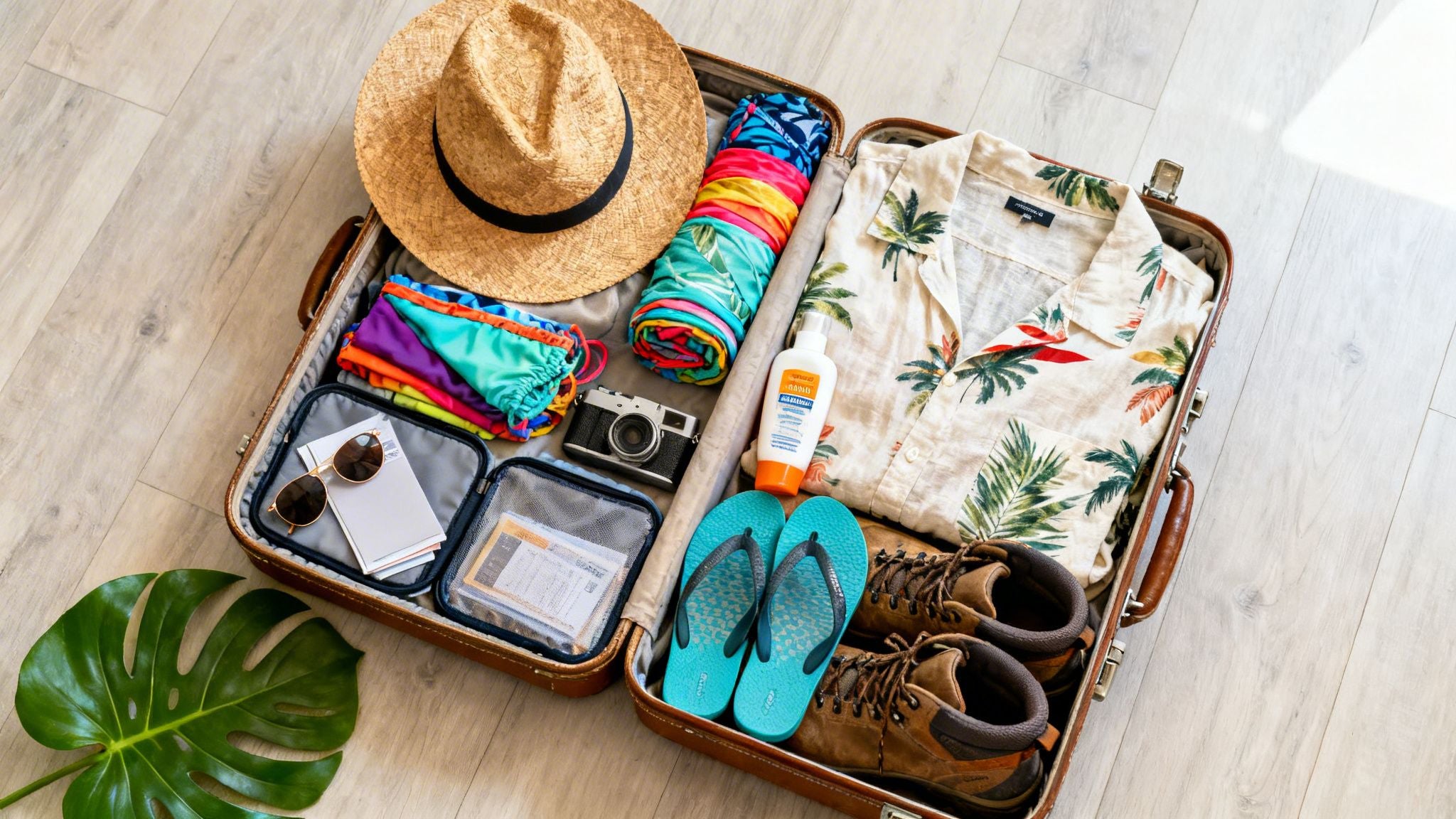
Even with the world's best lightweight bag, how you pack makes all the difference. Mastering a few simple techniques can feel like unlocking a secret level of packing, letting you bring everything you need without sitting on your suitcase to get it closed.
Here are four game-changing strategies:
-
Use Packing Cubes: I can't recommend these enough. They're brilliant for sorting your clothes and compressing them down to fit more in. Try using different cubes for tops, bottoms, and socks/underwear so you're not digging through everything to find one item.
-
Roll, Don't Fold: This is a classic for a reason—it works. Rolling clothes tightly makes them much more compact than folding them flat. As a bonus, it also helps minimize deep wrinkles, so your clothes are more likely to be ready-to-wear when you arrive.
-
Wear Your Heaviest Items: The oldest trick in the book! If you’re bringing that bulky jacket, your favorite heavy sweater, or a pair of boots, wear them on the plane. It frees up an incredible amount of weight and space inside your bag.
-
Utilize Every Nook and Cranny: Get to know your bag's layout. Softside bags often have great exterior pockets for things you need to grab quickly, like charging cables or a book. Hardside cases with a 50/50 clamshell opening are perfect for organization, letting you use the zippered dividers to separate clean clothes from dirty laundry or shoes from clothes.
When you combine a smart, lightweight suitcase with these packing habits, you’ll be unstoppable.
Ready to find the perfect travel companion? At Voyage Luggage, we’ve curated a world-class selection of lightweight luggage from the brands you trust. Explore our collections and discover the bag that will make your next trip the smoothest one yet. Shop our premium luggage today.

Share:
Briggs and Riley Lifetime Guarantee Your Complete Guide
Best Expandable Luggage: Your Guide to the best expandable luggage